


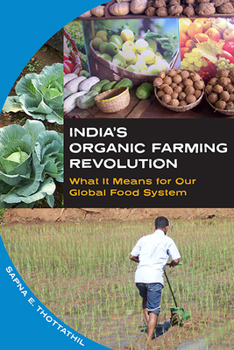
India's Organic Farming Revolution: What It Means for Our Global Food System
No Customer Reviews

Select Format
Select Condition 
Book Overview
Should you buy organic food? Is it just a status symbol, or is it really better for us? Is it really better for the environment? What about organic produce grown thousands of miles from our kitchens, or on massive corporately owned farms? Is "local" or "small-scale" better, even if it's not organic? A lot of consumers who would like to do the right thing for their health and the environment are asking such questions. Sapna Thottathil calls on us to rethink the politics of organic food by focusing on what it means for the people who grow and sell it--what it means for their health, the health of their environment, and also their economic and political well-being. Taking readers to the state of Kerala in southern India, she shows us a place where the so-called "Green Revolution" program of hybrid seeds, synthetic fertilizers, and rising pesticide use had failed to reduce hunger while it caused a cascade of economic, medical, and environmental problems. Farmers burdened with huge debts from buying the new seeds and chemicals were committing suicide in troubling numbers. Farm laborers suffered from pesticide poisoning and rising rates of birth defects. A sharp fall in biodiversity worried environmental activists, and everyone was anxious about declining yields of key export crops like black pepper and coffee. In their debates about how to solve these problems, farmers, environmentalists, and policymakers drew on Kerala's history of and continuing commitment to grassroots democracy. In 2010, they took the unprecedented step of enacting a policy that requires all Kerala growers to farm organically by 2020. How this policy came to be and its immediate economic, political, and physical effects on the state's residents offer lessons for everyone interested in agriculture, the environment, and what to eat for dinner. Kerala's example shows that when done right, this kind of agriculture can be good for everyone in our global food system.
Format:Paperback
Language:English
ISBN:1609382773
ISBN13:9781609382773
Release Date:October 2014
Publisher:University of Iowa Press
Length:228 Pages
Weight:0.95 lbs.
Dimensions:0.8" x 5.9" x 8.9"
Customer Reviews
0 rating
Copyright © 2026 Thriftbooks.com
Terms of Use | Privacy Policy | Do Not Sell/Share My Personal Information | Cookie Notice | Cookie Preferences | Accessibility Statement
ThriftBooks ® and the ThriftBooks ® logo are registered trademarks of Thrift Books Global, LLC
ThriftBooks ® and the ThriftBooks ® logo are registered trademarks of Thrift Books Global, LLC
