


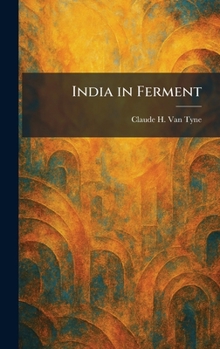
India in Ferment

"India in Ferment" provides an incisive firsthand look at the political and social upheaval defining India during the pivotal decade following the First World War. Written by the historian Claude H. Van Tyne, this work captures the atmosphere of a nation on the brink of profound change. The book examines the complex tensions between the British colonial administration and the burgeoning Indian independence movement, offering a scholarly yet accessible perspective on the rise of Mahatma Gandhi's non-cooperation movement and the growing spirit of nationalism.
Van Tyne details his travels across the subcontinent, documenting his conversations with both British officials and Indian leaders to present a multifaceted view of the Raj's declining authority and the internal struggles of a diverse society striving for self-determination. Through its analysis of the legislative reforms and the social dynamics of the era, the work remains a significant historical document for understanding the roots of modern India and the geopolitical shifts that reshaped the twentieth century. It is an essential read for students of colonial history, international relations, and the evolution of political movements in South Asia.
This work has been selected by scholars as being culturally important, and is part of the knowledge base of civilization as we know it. This work was reproduced from the original artifact, and remains as true to the original work as possible. Therefore, you may see the original copyright references, library stamps (as most of these works have been housed in our most important libraries around the world), and other notations in the work.
This work is in the public domain in the United States of America, and possibly other nations. Within the United States, you may freely copy and distribute this work, as no entity (individual or corporate) has a copyright on the body of the work.
As a reproduction of a historical artifact, this work may contain missing or blurred pages, poor pictures, errant marks, etc. Scholars believe, and we concur, that this work is important enough to be preserved, reproduced, and made generally available to the public. We appreciate your support of the preservation process, and thank you for being an important part of keeping this knowledge alive and relevant.
Customer Reviews
ThriftBooks ® and the ThriftBooks ® logo are registered trademarks of Thrift Books Global, LLC
