


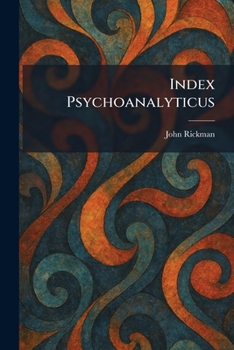
Index Psychoanalyticus

Select Format
Select Condition 
Book Overview
"Index Psychoanalyticus" is an essential bibliographic reference work that catalogs the foundational literature of the psychoanalytic movement. Compiled by John Rickman, this volume provides a systematic index of books and articles published between 1893 and 1926, capturing the intellectual explosion of the field during its most formative decades. The work serves as a detailed map of the emergence of psychoanalytic theory, documenting the contributions of Sigmund Freud and his circle, as well as the various practitioners and scholars who expanded the reach of depth psychology across the globe.
The index is an invaluable resource for historians of science and researchers in the fields of psychology and psychiatry. By organizing a vast corpus of early twentieth-century scholarly output, it allows for a clear view of the thematic developments, clinical breakthroughs, and theoretical shifts that defined the early psychoanalytic era. Focusing on the scholarly discourse of the time, "Index Psychoanalyticus" highlights the rigorous academic and clinical efforts required to establish psychoanalysis as a legitimate and influential discipline. This volume remains a critical tool for those seeking to trace the genealogy of psychological concepts and the history of mental health treatment.
This work has been selected by scholars as being culturally important, and is part of the knowledge base of civilization as we know it. This work was reproduced from the original artifact, and remains as true to the original work as possible. Therefore, you may see the original copyright references, library stamps (as most of these works have been housed in our most important libraries around the world), and other notations in the work.
This work is in the public domain in the United States of America, and possibly other nations. Within the United States, you may freely copy and distribute this work, as no entity (individual or corporate) has a copyright on the body of the work.
As a reproduction of a historical artifact, this work may contain missing or blurred pages, poor pictures, errant marks, etc. Scholars believe, and we concur, that this work is important enough to be preserved, reproduced, and made generally available to the public. We appreciate your support of the preservation process, and thank you for being an important part of keeping this knowledge alive and relevant.
Customer Reviews
ThriftBooks ® and the ThriftBooks ® logo are registered trademarks of Thrift Books Global, LLC
