


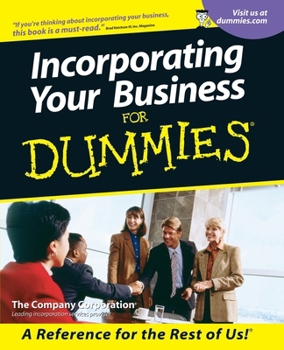
Incorporating Your Business for Dummies


Select Format
Select Condition 
Book Overview
If you're a business owner, incorporation can help you protect your personal assets and cut down your tax bill. But all the paperwork and legalese can make incorporation seem like more trouble than it's worth. Incorporating Your Business For Dummies offers all the savvy tips you need to get incorporated -- starting today Whether your business is big or small, incorporating isn't as simple as it could be. This handy reference makes incorporation make sense, and guides you through the process step by step. From handling the mountain of paperwork to getting back to business once you're finished, Incorporating Your Business For Dummies offers a wealth of helpful advice on these and many more topics: Knowing whether or not incorporation can help you Choosing the type of entity that will work best for your business Dealing with shareholders and shareholder agreements Transferring money and assets in or out of the corporation Documenting corporate actions and maintaining compliance Finding the right attorney, accountant, tax advisor, and other professionals Written by the experts at The Company Corporation, who handle more than 100,000 incorporations every year, this helpful book offers the kind of advice you can only get from professionals -- but in a user-friendly, lingo-free format. Whether you just want a little help with the paperwork, or don't even know what a corporation is, you'll find everything you need to know: What limited liability means Corporate statutes, bylaws, and articles Choosing directors and assigning duties The benefits of S corporation status Deciding where to incorporate Registering corporate names and domain names Balancing equity versus debt Understanding shareholder rights Getting your financial information in order Hiring a professional to help with corporate compliance If you want step-by-step help on setting up your corporation, dealing with the paperwork, and getting off on the right foot, Incorporating Your Business For Dummies is the only resource you need. Packed with the kind of tips and advice you'll find nowhere else, it's the uncomplicated way to get incorporated.
Format:Paperback
Language:English
ISBN:0764553410
ISBN13:9780764553417
Release Date:March 2001
Publisher:For Dummies
Length:320 Pages
Weight:1.22 lbs.
Dimensions:0.9" x 7.5" x 9.1"
Customer Reviews
5 ratings
Good book for those contemplating a corporation
Published by Thriftbooks.com User , 22 years ago
If you are contemplating starting a business and therefore a corporation, this book is a great first start. As with all of the dummy series books, the authors feel that people reading these books are brand new and know nothing. So this gives even the most naive a good start on how to incorporate.So much of the information is basic and since the book was written awhile ago, some of the material may be dated. Nonetheless, good first start for business people.Other good books include How To Start a S-Corporation by Robert Cooke and Brilliant Deductions by Wade Cook. The latter shows a way to drop out of the social security system and offers a good section on Nevada Corporations.
One of three must read books on corporations
Published by Thriftbooks.com User , 22 years ago
If you are just starting out, you will find a wealth of information in Incorporating Your Business For Dummies. Read this and learn.Two other books that are MUST READS are How To Incorporate: A Handbook for Entrepreneurs and Professionals by Michael R. Diamond and How To Start A "S" Corporation by Robert Cooke. You will also want to read a How To Incorporate (for your particular state), a series by J.W. Dicks. I purchased How To Incorporate and Start a Business in Minnesota and was very pleased.
Ignore first 2 reviews - this is a good book
Published by Thriftbooks.com User , 22 years ago
It is so blatantly obvious that the first two reviews were written by the same person--DUH! No doubt this individual would rather have you buy books onIncorporating by no-name self publishers who offer only generic advice.I previewed this book at Barnes & Noble and spoke with some other business people there who highly recommend this book. Now that I have read it and am using it, I recommend it also.In Incorporating for dummies you will learn-the advantages and disadvantages of incorporating-state and federal laws about corporations-the ins and outs of filing a corporate tax return-the 10 commonly made mistakes by small corporations-the best ways to create tax free medical benefits and retirement plans_a guide to business life after corporationsIncorporating your business for dummies is an excellent book for anyone in business. I also recommend Inc. Yourself by Judith H. McQuown and How To Launch a Business and Incorporate in any state by J.W.Dicks.Conversely, I bought some of the "self-published" books on the internet and on sale here and was terribly dissappointed. Never buy sight unseen.
Good book on how to incorporate your business
Published by Thriftbooks.com User , 22 years ago
I bought this book along with Rich Dad's Advisors; Own Your Own Corporation by Garrett Sutton.Incorporating Your Business for Dummies is a good book for the average reader. This book shows how to protect personal assets, save on taxes, set up your board of directors, conduct meetings and more.I especially enjoyed the part on how to create tax free medical benefits, pension and retirement plans. Very informative.For even more information, I recommend "Own Your Own Corporation" by Garrett Sutton and "How To Start a S Corporation" by Robert Cooke.
Great Book For Helping Entrepreneurs Understand Corporations
Published by Thriftbooks.com User , 23 years ago
"Incorporating Your Business For Dummies" is an excellent book for people forming a corporation or for those serving on the board of directors of a small corporation. The book clearly explains the roles/purposes of articles of incorporation, bylaws, consent resolutions, minutes of shareholder's meetings, shareholders, officers, directors, and how not to inadvertently compromise the corporate structure and expose officers, directors, and shareholders to personal liability.Corporations, as separate legal entities, have no ability to act on their own. Corporations are owned by shareholders who typically elect a board of directors who set general policy for the corporation. Typically, the board of directors selects officers who manage the day-to-day operations of the corporation (some states allow 'close corporations' which allow smaller corporations to eliminate a board of directors and some of the other corporate formalities)."Incorporating Your Business For Dummies" has an excellent chapter about the need to document authorized corporate actions. If meetings are held, minutes of the meeting document actions approved by either the shareholders or by the board of directors. If you form a one-person corporation, documenting action will probably be done with consent resolutions.Some smaller corporations may fail to document corporate decision-making properly. This is one factor that can be used to "pierce the corporate veil" and impose personal liability. "Incorporating Your Business For Dummies" does an excellent job of explaining compliance issues that are necessary to shield individuals from liability and keep a corporate structure intact.A very short (3-page) chapter does an excellent job of discussing where to incorporate. Incorporating in Delaware is discussed. However, many people misunderstand state taxation of corporations. Corporations must qualify to "do business" in each state in which they have employees and property (the book does a good job of discussing qualifying to do business in other states). A corporation is subject to all state laws and taxation of every state in which it does business. So, if you do business in Minnesota and incorporate in Delaware, you're subject to Minnesota state income taxation. (In short, if you plan to "do business" in many states or go public, the authors argue Delaware is a good choice, but if your business "does business" in only one state, that one state probably is your best choice.)Choosing a corporate name and forming a corporation are covered. The role of shareholder's agreements is discussed.One weakness of the book is the lack of discussion of corporate taxation. (The book says consult your tax advisor, which is good advice. But, you might want to know more. Another good book with more of a tax-focus is "Inc. Yourself"). For example, the role of IRS Section 1244 stock is touched upon only briefly. Section 1244 stock allows a complete corporate failure to be offset against ordinary income, which m
Copyright © 2026 Thriftbooks.com Terms of Use
| Privacy Policy | Do Not
Sell/Share My Personal Information | Cookie Policy | Cookie Preferences | Accessibility Statement
ThriftBooks® and the ThriftBooks® logo are registered trademarks of Thrift Books Global, LLC
ThriftBooks® and the ThriftBooks® logo are registered trademarks of Thrift Books Global, LLC
