


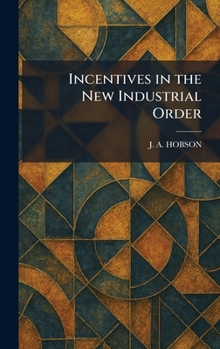
Incentives in the New Industrial Order

In "Incentives in the New Industrial Order", the influential economist J. A. Hobson provides a profound analysis of the shifting economic landscape following the First World War. This work addresses a critical question of the modern age: how can industrial efficiency and productivity be maintained as the traditional motives of private profit and competitive pressure begin to recede? Hobson explores the psychological foundations of labor and capital, examining whether new social incentives can effectively replace the old drivers of the capitalist system.
As industrial societies moved toward greater socialization and collective control, Hobson argued that a deeper understanding of human motivation was required to prevent stagnation. The book delves into the roles of management, manual labor, and the consumer, seeking a balanced "new order" that prioritizes social welfare without sacrificing progress. By analyzing the potential for representative government within industry and the redistribution of surplus wealth, Hobson offers a visionary perspective on the evolution of economic life.
This volume remains an essential text for those interested in the history of economic thought, the development of social democracy, and the perennial challenge of aligning individual ambition with the common good. Hobson's clear-eyed evaluation of the "incentive problem" continues to resonate in contemporary debates over work-life balance, corporate responsibility, and economic justice.
This work has been selected by scholars as being culturally important, and is part of the knowledge base of civilization as we know it. This work was reproduced from the original artifact, and remains as true to the original work as possible. Therefore, you may see the original copyright references, library stamps (as most of these works have been housed in our most important libraries around the world), and other notations in the work.
This work is in the public domain in the United States of America, and possibly other nations. Within the United States, you may freely copy and distribute this work, as no entity (individual or corporate) has a copyright on the body of the work.
As a reproduction of a historical artifact, this work may contain missing or blurred pages, poor pictures, errant marks, etc. Scholars believe, and we concur, that this work is important enough to be preserved, reproduced, and made generally available to the public. We appreciate your support of the preservation process, and thank you for being an important part of keeping this knowledge alive and relevant.
Customer Reviews
ThriftBooks ® and the ThriftBooks ® logo are registered trademarks of Thrift Books Global, LLC
