


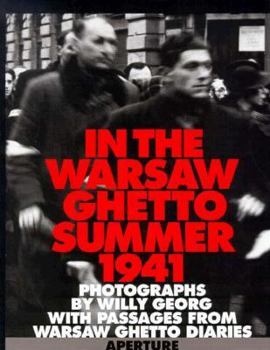
In the Warsaw Ghetto: Summer 1941

Select Format
Select Condition 
Book Overview
The comments and observations of ghetto residents accompany photographs of Jewish ghetto life in 1941 Warsaw. This description may be from another edition of this product.
Format:Hardcover
Language:English
ISBN:0893815268
ISBN13:9780893815264
Release Date:January 1
Publisher:Aperture Foundation, Incorporated
Length:111 Pages
Weight:1.95 lbs.
Dimensions:10.8" x 0.8" x 9.5"
Related Subjects
Arts, Music & Photography Europe History Military Photography Poland World World War IICustomer Reviews
2 ratings
Less we Forget...
Published by Thriftbooks.com User , 26 years ago
This book is a powerful reminder of a time we should never forget. In 1941 a German soldier Willy Georg went into the Warsaw Ghetto and took some pictures. Without meaning to he documented for history what life was like for the Jews in the Polish Ghetto before it was raised to the ground by the Nazis and most of its occupants massacred. Willy Georg is not a hero, he did nothing to help the people of the Ghetto, all he did was prove that they had existed at all. This book is tragic as it is magnificent. The accompanying text is concise and well written, showing the reader along with the photos how people lived and died in Warsaw during the early 1940s. This book should be on every library shelf and every school from Junior to High should have access to it. Sometimes pictures can speak louder than words and in this case it is more than true.
Powerful and poignant
Published by Thriftbooks.com User , 28 years ago
The origin of this book is in of itself remarkable. In the summer of 1941, Willie Georg (a German soldier stationed in Warsaw), was given a pass by his commanding officer that allowed him to enter the Warsaw Ghetto--a 1.36 square mile area into which 500,000 Jews had been packed. "There are some curious goings-on behind that wall," said the officer. "Take your [camera]...and bring back some photos of what you find." George did this, but the photographs he took have waited over five decades to see publication. Jewish scholar Rafael F. Scharf has collected these poignant, powerful images into a volume supplimented by excerpts from the diaries of Warsaw Ghetto Jews. The result is a book that brings the past to life with vivid and literally painful clarity. The Ghetto was deliberately created by the Nazis as a place for Jews to slowly died from hunger, cold and disease. (Georg's photos were taken a little less than a year before the death camps opened for large-scale business.) Every page is an portrait--in words or pictures--of people the reader knows almost certainly died before the war ended. It's impossible to look at these images without feeling a sense of loss on a purely human level. Old men, women, children, their faces gaunt with hunger, are seen still struggling to live a life of sorts, but it is clearly a struggle they are losing. IN THE WARSAW GHETTO is a reminder that every person who suffered and died under the Nazi regime was a fellow human being--that each and every one of those deaths was an ineffacable tragedy.
Copyright © 2026 Thriftbooks.com
Terms of Use | Privacy Policy | Do Not Sell/Share My Personal Information | Cookie Policy | Cookie Preferences | Accessibility Statement
ThriftBooks ® and the ThriftBooks ® logo are registered trademarks of Thrift Books Global, LLC
ThriftBooks ® and the ThriftBooks ® logo are registered trademarks of Thrift Books Global, LLC
