


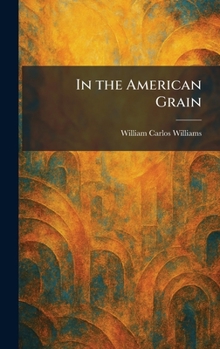
In the American Grain


Select Format
Select Condition 
Book Overview
"In the American Grain" is a profound and evocative exploration of the American historical consciousness, written by the celebrated poet William Carlos Williams. Through a series of lyrical essays and vignettes, Williams reimagines the figures and events that shaped the New World, from the earliest European explorers to the founding fathers and beyond. By re-examining individuals such as Christopher Columbus, Hern n Cort s, Daniel Boone, and Abraham Lincoln, the work seeks to uncover a visceral narrative of the American experience that stands in contrast to conventional, academic history.
Blending meticulous research with a poetic sensibility, "In the American Grain" delves into the psychological and cultural foundations of the United States. Williams critiques the Puritan influence on the American character while celebrating those who engaged directly with the raw beauty and danger of the continent. This collection is a landmark of modernist literature, offering a unique perspective on national identity through a prose style that is both rhythmic and piercing. It remains an essential read for those interested in the intersections of literature, philosophy, and the myth-making of American history.
This work has been selected by scholars as being culturally important, and is part of the knowledge base of civilization as we know it. This work was reproduced from the original artifact, and remains as true to the original work as possible. Therefore, you may see the original copyright references, library stamps (as most of these works have been housed in our most important libraries around the world), and other notations in the work.
This work is in the public domain in the United States of America, and possibly other nations. Within the United States, you may freely copy and distribute this work, as no entity (individual or corporate) has a copyright on the body of the work.
As a reproduction of a historical artifact, this work may contain missing or blurred pages, poor pictures, errant marks, etc. Scholars believe, and we concur, that this work is important enough to be preserved, reproduced, and made generally available to the public. We appreciate your support of the preservation process, and thank you for being an important part of keeping this knowledge alive and relevant.
Customer Reviews
Cotton Mather: Fat and Dumb?
Perspective on American Culture
ThriftBooks ® and the ThriftBooks ® logo are registered trademarks of Thrift Books Global, LLC
