


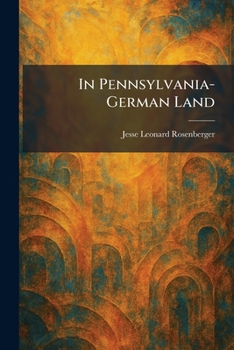
In Pennsylvania-German Land

"In Pennsylvania-German Land" by Jesse Leonard Rosenberger offers a compelling and detailed exploration of the cultural, social, and religious history of the Pennsylvania German people. This work delves into the unique traditions and enduring legacy of the communities often referred to as the Pennsylvania Dutch, with a particular focus on their rural lifestyles and religious sects, including the Mennonites.
The narrative captures the essence of a people who successfully maintained their distinct identity, language, and customs while contributing significantly to the development of the United States. Rosenberger examines various facets of daily life, from agricultural practices and home life to the deep-seated spiritual values that guided these communities. By documenting historical anecdotes and local lore, the book serves as an important record of an ethnic group whose influence remains visible in the architecture and culture of the region today.
Readers interested in American regional history, ethnic studies, and genealogy will find "In Pennsylvania-German Land" to be an invaluable resource. It provides a window into the past, preserving the heritage of a group that played a foundational role in the Middle Atlantic states.
This work has been selected by scholars as being culturally important, and is part of the knowledge base of civilization as we know it. This work was reproduced from the original artifact, and remains as true to the original work as possible. Therefore, you may see the original copyright references, library stamps (as most of these works have been housed in our most important libraries around the world), and other notations in the work.
This work is in the public domain in the United States of America, and possibly other nations. Within the United States, you may freely copy and distribute this work, as no entity (individual or corporate) has a copyright on the body of the work.
As a reproduction of a historical artifact, this work may contain missing or blurred pages, poor pictures, errant marks, etc. Scholars believe, and we concur, that this work is important enough to be preserved, reproduced, and made generally available to the public. We appreciate your support of the preservation process, and thank you for being an important part of keeping this knowledge alive and relevant.
Related Subjects
HistoryCustomer Reviews
ThriftBooks ® and the ThriftBooks ® logo are registered trademarks of Thrift Books Global, LLC
