


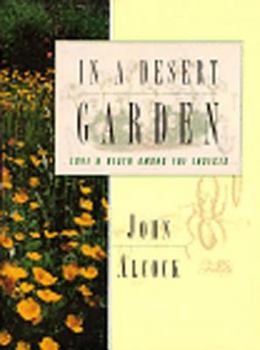
In a Desert Garden: Love and Death Among the Insects

Select Format
Select Condition 
Book Overview
With canny insight and bone-dry wit, John Alcock, a specialist in the ecology of the American Southwest, introduces us to the lives and loves of desert insects as they forage through his backyard oasis. Creating his own desert garden behind his suburban home in Tempe, Arizona, Alcock scrutinizes every square inch of soil detailing the exotic plant life he finds and offering tips on its peccadilloes and preservation.
The true heroes of this story, however, are the bugs of Alcock's backyard. We are drawn into complex plots almost biblical in nature of life and love, survival and death. Two male earwigs caught in each other's pincers battle for a prized female. A female mantis finishes copulating, beheads her mate, and cannibalizes his body for its precious protein.
With each detail, Alcock pieces together the entire ecosystem of his desert paradise. Always amusing and instructive, and sometimes dramatic, In a Desert Garden provides an eye-opening meditation on the joys of planting, weeding, pruning, and, most of all, bug-hunting.
The true heroes of this story, however, are the bugs of Alcock's backyard. We are drawn into complex plots almost biblical in nature of life and love, survival and death. Two male earwigs caught in each other's pincers battle for a prized female. A female mantis finishes copulating, beheads her mate, and cannibalizes his body for its precious protein.
With each detail, Alcock pieces together the entire ecosystem of his desert paradise. Always amusing and instructive, and sometimes dramatic, In a Desert Garden provides an eye-opening meditation on the joys of planting, weeding, pruning, and, most of all, bug-hunting.
Format:Hardcover
Language:English
ISBN:0393041182
ISBN13:9780393041187
Release Date:September 1997
Publisher:W. W. Norton & Company
Length:192 Pages
Weight:1.45 lbs.
Dimensions:0.7" x 7.9" x 10.4"
Customer Reviews
3 ratings
Story of a Front Yard
Published by Thriftbooks.com User , 20 years ago
This book relates some of the observations that Alcock made when he converted his grassy lawn in front of his Arizona house from grass to desert flora. In his neighborhood, residents dutifully maintained wide swaths of green grass through continuous fertilizing, watering, cutting, and trimming. They controlled pests and weeds through spraying, but if they missed one chemical treatment or watering, unwanted species would begin to take over. When Alcock first moved to the area, he went along with local custom for several years. Finally, he asked himself why he was working so hard to maintain grass at such high economic and environmental costs, when it was really the desert surroundings that he enjoyed. It took some effort to kill his lawn and replace it with a yard filled with thriving desert species, but maintenance eventually became much easier and cheaper once he had landscaping fit for the local environment. As an entomologist, Alcock greatly enjoys observing the insect life in his new yard. In this book, as well as describing how he transformed his yard, he also describes such insects as ladybugs, praying mantises, earwigs, desert termites, paper wasps, bees, grasshoppers, inchworms, whiteflies, mayflies, and aphids. The book is arranged into chapters by topic, including chapters on insects that control pests, compost lovers, insects that sting, camouflage experts, alien insects, and migrating insects. In reading the book, I was struck by how fascinating the lowly insect species can be. The book is written in an informal style appropriate for general readers. It is illustrated with black and white drawings by Turid Forsyth. Scientific sources are listed in a bibliography at the end of the book (but not referenced directly in the text), and there is an index.
Nature, neighbours and night quests
Published by Thriftbooks.com User , 21 years ago
John Alcock loves Nature. Sometimes, though, getting from a suburban home to the wilderness he relishes can be tedious. So he brought some of his favoured Sonoran Desert environment to his front yard. Using a ramshackle Kubota tractor, he stripped away the layer of Bermuda grass surrounding his house. Over time, and with no little effort, he transformed that yard into a little pocket of desert environment. All this was more than an exercise in redecorating, however. Alcock studies insects, especially their mating rituals, and this transplanted environment gave him ample opportunity. Even if his practice of crouching over desert shrubbery at odd hours raised a few neighbourhood eyebrows.Alcock loves what he does, imparting his passion to us with lively prose. His academic background merges with his expressions of feeling to keep this book a delight to read. This blending places his writing skills in a comfortable [and comforting] niche somewhere between E. O. Wilson and John McPhee or David Quammen. He keeps you at ease as he builds the desert floor, inserts shrubbery and vegetables, and welcomes the bird and insect visitors to his creation. He protects the native species of plants and animals where possible, but doesn't summarily reject harmless exotics. And he carefully explains how to tell the difference.The underlying reason for the garden's transformation was to attract insects. Alcock is at his best in watching, analysing and explaining the life styles of desert bees, wasps, beetles and the rest. How did they develop those behaviours? What do their activities it mean to us humans, who are too often ardently killing the ones in our own gardens. He poses his questions with the puzzlement of fresh discovery. Then, adroitly picking through the available evidence - while calling out for further studies - he sifts through the optional answers to deliver the most likely, and most logical scenario. Yet, at no point are you being "lectured to". Instead, you are introduced to some of the awesome array of variation nature offers. This is no specialist's daunting lecture, but the confessions of a man who finds wonder in small things. It's also, of course, an example for any reader to enter his own yard to consider restoring it some state of origins instead of developer's artificiality.Alcock's view of his environment isn't wholly without concerns, however. There's no question of his concern for the impact of unrestricted "development". Phoenix, the urban hub of his home in Tempe, is one of the fastest growing cities in the US. With reconstructed landscapes, imported species, proliferating golf courses and a staggering consumption of water, this emblem of "progress" is another urban blight on the landscape. Alcock is uncomfortable with this situation, but nearly helpless to block it. His example of bringing some of the countryside into the city and restoring a bit of balance at a time is an example we should all consider careful
Fabulous, witty, insightful
Published by Thriftbooks.com User , 26 years ago
I thoroughly enjoyed this intersting, thought provoking book from John Alcock. His thoughts on the modern American lawn should be required reading in the suburbs. The world would be a better place if all would read and comprehend his thoughts on connecting ourselves to the myriad wonders that go on all around us every day.
Copyright © 2026 Thriftbooks.com Terms of Use
| Privacy Policy | Do Not
Sell/Share My Personal Information | Cookie Policy | Cookie Preferences | Accessibility Statement
ThriftBooks® and the ThriftBooks® logo are registered trademarks of Thrift Books Global, LLC
ThriftBooks® and the ThriftBooks® logo are registered trademarks of Thrift Books Global, LLC
