


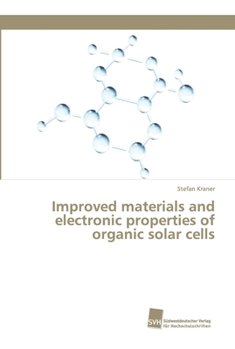
Improved materials and electronic properties of organic solar cells
No Customer Reviews

In current organic photovoltaic devices, the loss in energy caused by the inevitable charge transfer step leads to a low open circuit voltage, which is one of the main reasons for rather low power conversion efficiencies. A possible approach to increase the voltage is to lower the exciton binding energy, which can be accomplished by materials with a higher dielectric constant. It is shown how to calculate the dielectric constant with ionic and electronic contributions and how to obtain the exciton binding energy by using the density functional theory framework. We obtain a lower limit of the exciton binding energy for different commonly used one dimensional molecules, and an improved dielectric constant for a ladder polymer with polar side-chains. Different arrangements of a donor and an acceptor molecules are discussed in terms of the exciton binding energy of the respective charge transfer state. It is shown that a spatial separation between the donor and acceptor molecule can lower the exciton binding energy by a factor of two.
Format:Paperback
Language:English
ISBN:6202320249
ISBN13:9786202320245
Release Date:September 2017
Publisher:Sudwestdeutscher Verlag Fur Hochschulschrifte
Length:152 Pages
Weight:0.51 lbs.
Dimensions:0.3" x 6.0" x 9.0"
Customer Reviews
0 rating
Copyright © 2026 Thriftbooks.com
Terms of Use | Privacy Policy | Do Not Sell/Share My Personal Information | Cookie Policy | Cookie Preferences | Accessibility Statement
ThriftBooks ® and the ThriftBooks ® logo are registered trademarks of Thrift Books Global, LLC
ThriftBooks ® and the ThriftBooks ® logo are registered trademarks of Thrift Books Global, LLC
