


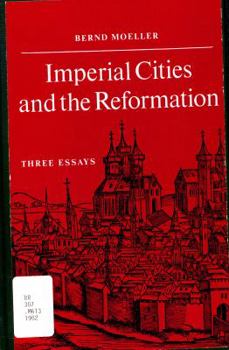
Imperial Cities and the Reformation: Three Essays

Select Format
Select Condition 
Book Overview
English summary: Imperial Cities and the Reformation, first published in 1962, has stimulated the discussions in the field of Reformation research enormously, in Germany as well as in the English... This description may be from another edition of this product.
Format:Paperback
Language:English
ISBN:0939464047
ISBN13:9780939464043
Release Date:January 1982
Publisher:Labyrinth Press
Length:115 Pages
Weight:0.50 lbs.
Dimensions:0.4" x 5.7" x 8.8"
Customer Reviews
1 rating
Reformation theology, in the context of political and social history
Published by Thriftbooks.com User , 19 years ago
"[Luther] through his seeing the most important province in its distinctive character, the rights of all others also were to be vindicated, ..., the State is no longer the disastrous combination of compulsion and need, so constructed as to lean for support on the Church...,... the civil calling...is no longer viewed...as an occupation withdrawing the thoughts from heaven, but is the true spiritual province..." A. von Harnack, History of Dogma Machiavelli on Free Imperial Cities: 'The cities of Germany are completely free,' wrote Niccolò Machiavelli in The Prince, 'they have little surrounding territory, they obey the emperor when they wish,... .' It is testimony to the general standing of urban culture in the Holy Roman Empire that a keen observer like Machiavelli could suggest that the German cities were 'completely free' and that they might obey the Emperor 'when they wish'. But the truth was not quite so impressive. When 'The Prince' was written, Machiavelli described possibley sixty-nine of the Free Imperial Cities, a small part of the German cities in his time, Ca. 2,500 strongholds. Of all cities, very few would make the claim that they were absolutely independent. Nor was Machiavelli correct to assume that these cities were urban, with little surrounding territory. Free and imperial cities: The free and imperial cities were a privileged elite among the 2,500 or so towns within the Holy Roman Empire. The term 'free city' applied to towns historically founded by a bishop, that later won self-governance. The 'imperial cities' dated back to settlements established by the emperor or under his direct protection. By 1500 the free and imperial cities became commonly under the immediate jurisdiction of the emperor, to whom they paid annual tribute. This distinction included the imperial cities as part of the 'Imperial Estates that emerged and governed the empire with the emperor by institutions as the Reichstag, Imperial Diet. Only less than one hundred towns ever possessed this special status. Mostly concentrated in in the southwest (Swabia and Franconia), which had been the centers of the emperor's power at the time of the cities' foundation in the twelfth century. Others developed in the Rhineland and northern Germany, either by escaping the control of local bishops or by emerging independently from below as trading centers that acquired imperial protection. Each city was a self-governing commune controlled by a council (Rat) elected by the enfranchised citizens (Bürger). Citizenship had to be applied for and was dependent on paying specific taxes and serving in the urban militia. Generally, the social structure of the imperial cities reflected that of the territorial towns. Urban trades were organized into guilds that regulated their own affairs under the council's jurisdiction. Many princes resented the cities' autonomy and sought to integrate these dynamic urban centers into their territories. All urban alliances ended in military d
Copyright © 2026 Thriftbooks.com
Terms of Use | Privacy Policy | Do Not Sell/Share My Personal Information | Cookie Policy | Cookie Preferences | Accessibility Statement
ThriftBooks ® and the ThriftBooks ® logo are registered trademarks of Thrift Books Global, LLC
ThriftBooks ® and the ThriftBooks ® logo are registered trademarks of Thrift Books Global, LLC
