


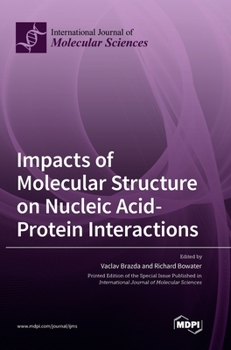
Impacts of Molecular Structure on Nucleic Acid-Protein Interactions

Interactions between nucleic acids and proteins are essential requirements for the viability of cellular life because they are indispensable for many basic biological processes. DNA is typically presented as a specific double-stranded helical structure, but nucleic acids have great structural flexibility. Current knowledge demonstrates that the structural conformations of nucleic acids play critical roles in protein-DNA interactions. This book presents a collection of research findings published in the Special Issue of the International Journal of Molecular Sciences, titled "Impacts of Molecular Structure on Nucleic Acid-Protein Interactions".
The breadth of research findings reported here demonstrates that the structural flexibility of nucleic acids plays critical roles in their interactions with proteins, with important implications across a range of human diseases, including cancer and some infectious diseases.
Prof. Richard Bowater
University of East Anglia, Norwich, United Kingdom
Prof. V clav Br zda
Institute of Biophysics of the Czech Academy of Sciences, Brno, Czech Republic
Customer Reviews
ThriftBooks® and the ThriftBooks® logo are registered trademarks of Thrift Books Global, LLC
