


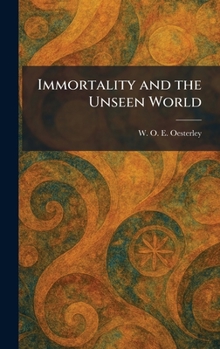
Immortality and the Unseen World

"Immortality and the Unseen World" is a profound scholarly exploration into the origins and evolution of beliefs regarding the afterlife and the spiritual realm within ancient Semitic traditions and the Old Testament. Written by the esteemed theologian W.O.E. Oesterley, this work delves into the complex history of how ancient peoples perceived death, the soul, and the existence of a world beyond the physical.
The book meticulously examines archaeological evidence, linguistic nuances, and historical texts to trace the development of eschatological thought. Oesterley analyzes early concepts of Sheol, the nature of spirits, and the gradual shift toward a more defined understanding of immortality. By comparing Hebrew traditions with those of neighboring cultures, the author provides a comprehensive overview of the religious landscape that shaped early theological perspectives.
Ideal for students of theology, history, and comparative religion, "Immortality and the Unseen World" remains a vital resource for understanding the foundational concepts of life after death in the Judeo-Christian tradition. This insightful study offers readers a clear window into the ancient mind, revealing the enduring human quest to understand the mysteries of the unseen world.
This work has been selected by scholars as being culturally important, and is part of the knowledge base of civilization as we know it. This work was reproduced from the original artifact, and remains as true to the original work as possible. Therefore, you may see the original copyright references, library stamps (as most of these works have been housed in our most important libraries around the world), and other notations in the work.
This work is in the public domain in the United States of America, and possibly other nations. Within the United States, you may freely copy and distribute this work, as no entity (individual or corporate) has a copyright on the body of the work.
As a reproduction of a historical artifact, this work may contain missing or blurred pages, poor pictures, errant marks, etc. Scholars believe, and we concur, that this work is important enough to be preserved, reproduced, and made generally available to the public. We appreciate your support of the preservation process, and thank you for being an important part of keeping this knowledge alive and relevant.
Customer Reviews
ThriftBooks ® and the ThriftBooks ® logo are registered trademarks of Thrift Books Global, LLC
