


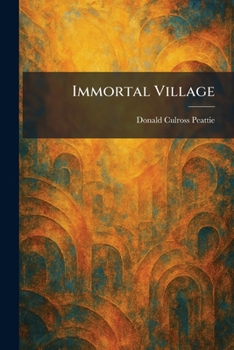
Immortal Village

Select Format
Select Condition 
Book Overview
"Immortal Village" is a lyrical and evocative chronicle of the town of Vence, nestled in the mountains of Provence. Written with the keen eye of a naturalist and the heart of a historian, Donald Culross Peattie traces the long, storied life of this French village from its prehistoric beginnings through the Roman era, the Middle Ages, and into the modern world.
The work serves as a profound meditation on the resilience of human civilization and the enduring power of place. Peattie explores how Vence survived the tumult of European history, including religious wars, plagues, and the shifting borders of empires. By focusing on a single geographical point, the author provides an intimate perspective on the broader currents of Western history, blending vivid descriptions of the Mediterranean landscape with a deep appreciation for the customs and character of its people.
Rich in botanical detail and philosophical insight, "Immortal Village" is more than a local history; it is a celebration of the continuity of life. Peattie's prose brings the stones, flora, and inhabitants of the region to life, offering readers a timeless look at the intersection of nature and human heritage in one of the most beautiful corners of France.
This work has been selected by scholars as being culturally important, and is part of the knowledge base of civilization as we know it. This work was reproduced from the original artifact, and remains as true to the original work as possible. Therefore, you may see the original copyright references, library stamps (as most of these works have been housed in our most important libraries around the world), and other notations in the work.
This work is in the public domain in the United States of America, and possibly other nations. Within the United States, you may freely copy and distribute this work, as no entity (individual or corporate) has a copyright on the body of the work.
As a reproduction of a historical artifact, this work may contain missing or blurred pages, poor pictures, errant marks, etc. Scholars believe, and we concur, that this work is important enough to be preserved, reproduced, and made generally available to the public. We appreciate your support of the preservation process, and thank you for being an important part of keeping this knowledge alive and relevant.
Customer Reviews
ThriftBooks ® and the ThriftBooks ® logo are registered trademarks of Thrift Books Global, LLC
