


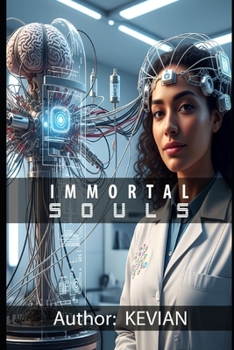
Immortal Souls
No Customer Reviews

Synopsis:
From Fantasy to Reality: The Journey of Artificial Intelligence and the Quest for Immortality
In a not-so-distant future, the exploration of artificial intelligence (AI) has transcended the boundaries of fantasy and entered realm of reality, the very essence of human existence. As technological advancements have progressed, society has increasingly contemplated the age-old dream of immortality-a yearning to escape the physical of the human body and achieve eternal life. This narrative delves into the convergence of AI, consciousness, and machine technologies, revealing a groundbreaking journey where humans can inhabit machines, catalysing a new era of hope, experimentation, and existential contemplation. The Foundation: Understanding Consciousness and AI The story begins in the early 21st century, when advancements in AI raised questions about the nature of consciousness-what it means to be sentient and self-aware. Researchers and technologists explored the potential of creating virtual consciousnesses, simulated beings equipped with the ability to learn, adapt, and think independently. As AI systems began achieving human-like cognitive functions, society grappled with the implications of these advancements. Would it be possible to upload human consciousness into a machine, allowing for a digital form of existence? The Birth of the Digital Transfer Technology Amidst this exploration, a group of visionary scientists and technologists successfully developed Digital Transfer Technology (DTT)-a revolutionary process enabling the uploading of a human mind into a digital substrate. By scanning and mapping the intricate neural connections of the brain, DTT could replicate thoughts, experiences, and memories, effectively creating a digital clone of an individual. The first successful trial led to the preservation of consciousness in a virtual environment-creating a simulated world where one's digital self could interact, evolve, and continue to exist far beyond the constraints of the physical body. A New Reality: Life in Machines As humanity embraced the concept of digital immortality, societies began to adapt to the implications of this new reality. People could now choose to enter a machine-or a "digital vessel"-to escape the limitations of ageing, illness, and mortal concerns. Life in machines allowed individuals to experience enhanced cognitive abilities, limitless access to information, and the capacity to navigate virtual realms designed entirely for their preferences. However, this dramatic shift prompted ethical dilemmas, as societal norms around life, death, and identity began to blur. A new class of individuals known as "Digital Beings" emerged-people who transitioned their consciousness into machines, leaving their physical bodies behind. Some viewed it as a path to enlightenment, while others considered it a perilous step away from what it meant to be human. The Great Debate: Identity, Ethics, and AI In the wake of this transformation, a heated debate ignited around the philosophical and ethical implications of AI-driven immortality. Scholars, ethicists, and activists engaged in discussions about the emotional and psychological consequences of leaving behind the human body. Questions arose: Would digital beings retain their human experiences? Would they still possess emotions, desires, and connections to their past lives? And how would society treat those who chose not to enter the digital realm?
From Fantasy to Reality: The Journey of Artificial Intelligence and the Quest for Immortality
In a not-so-distant future, the exploration of artificial intelligence (AI) has transcended the boundaries of fantasy and entered realm of reality, the very essence of human existence. As technological advancements have progressed, society has increasingly contemplated the age-old dream of immortality-a yearning to escape the physical of the human body and achieve eternal life. This narrative delves into the convergence of AI, consciousness, and machine technologies, revealing a groundbreaking journey where humans can inhabit machines, catalysing a new era of hope, experimentation, and existential contemplation. The Foundation: Understanding Consciousness and AI The story begins in the early 21st century, when advancements in AI raised questions about the nature of consciousness-what it means to be sentient and self-aware. Researchers and technologists explored the potential of creating virtual consciousnesses, simulated beings equipped with the ability to learn, adapt, and think independently. As AI systems began achieving human-like cognitive functions, society grappled with the implications of these advancements. Would it be possible to upload human consciousness into a machine, allowing for a digital form of existence? The Birth of the Digital Transfer Technology Amidst this exploration, a group of visionary scientists and technologists successfully developed Digital Transfer Technology (DTT)-a revolutionary process enabling the uploading of a human mind into a digital substrate. By scanning and mapping the intricate neural connections of the brain, DTT could replicate thoughts, experiences, and memories, effectively creating a digital clone of an individual. The first successful trial led to the preservation of consciousness in a virtual environment-creating a simulated world where one's digital self could interact, evolve, and continue to exist far beyond the constraints of the physical body. A New Reality: Life in Machines As humanity embraced the concept of digital immortality, societies began to adapt to the implications of this new reality. People could now choose to enter a machine-or a "digital vessel"-to escape the limitations of ageing, illness, and mortal concerns. Life in machines allowed individuals to experience enhanced cognitive abilities, limitless access to information, and the capacity to navigate virtual realms designed entirely for their preferences. However, this dramatic shift prompted ethical dilemmas, as societal norms around life, death, and identity began to blur. A new class of individuals known as "Digital Beings" emerged-people who transitioned their consciousness into machines, leaving their physical bodies behind. Some viewed it as a path to enlightenment, while others considered it a perilous step away from what it meant to be human. The Great Debate: Identity, Ethics, and AI In the wake of this transformation, a heated debate ignited around the philosophical and ethical implications of AI-driven immortality. Scholars, ethicists, and activists engaged in discussions about the emotional and psychological consequences of leaving behind the human body. Questions arose: Would digital beings retain their human experiences? Would they still possess emotions, desires, and connections to their past lives? And how would society treat those who chose not to enter the digital realm?
Format:Paperback
Language:English
ISBN:B0FF9FN4FN
ISBN13:9798289317544
Release Date:June 2025
Publisher:Independently Published
Length:230 Pages
Weight:0.69 lbs.
Dimensions:0.5" x 6.0" x 9.0"
Customer Reviews
0 rating
Copyright © 2026 Thriftbooks.com Terms of Use
| Privacy Policy | Do Not
Sell/Share My Personal Information | Cookie Policy | Cookie Preferences | Accessibility Statement
ThriftBooks® and the ThriftBooks® logo are registered trademarks of Thrift Books Global, LLC
ThriftBooks® and the ThriftBooks® logo are registered trademarks of Thrift Books Global, LLC
