


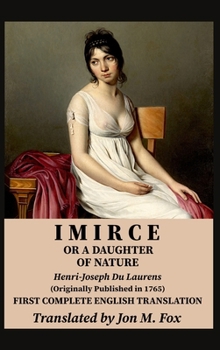
Imirce, or A Daughter of Nature: First Complete English Translation. Annotated.

I was born in France. I don't know in which province.
I knew neither father nor mother.
My childhood lasted twenty-two years.
Until that age, I saw neither the sky nor the earth....
Thus begins the story of Imirce, or a Daughter of Nature.
This is the first full translation of Imirce, ou la Fille de la Nature in any language. Only a partial, censored translation appeared in print in an English language collection of stories published in 1787. All other editions of the book have been in French, with the last printed in a partial limited edition in 1922, and an annotated French version in 1998..
As a figure who straddled the Enlightenment, Du Laurens is among the most enigmatic and scandalous authors in literary history. Due to his radically anticlerical, and often erotically pornographic, writings, his opponents accused him of deism or atheism, as well as immorality and obscenity. His works were all printed clandestinely under various pseudonyms and were immediately persecuted upon publication. The authorship of some works has only been established in recent years.
The theme of the central story is the socialization of Imirce, who has grown up in isolation, and the potential for social criticism unleashed by this situation. Ignorant and naive, but also free of prejudice, Imirce reacts with astonishment and outrage to the absurdity and injustice of social reality. That this work is intended as a sharp contrast to Rousseau, with whom Du Laurens disagreed, and his novel mile, is conveniently overlooked by some in its assessment. The additional related tales look at other aspects of society and the world, as Du Laurens observed them.
This important work of the Enlightenment, in which a woman is the subject of thought-provoking yet cruel experiments by a 'rich philosopher', tells the story of a bizarre, Rousseauian project involving a young girl who is bought shortly after her birth, in order to confine her blindfolded in a stone cellar for 22 years.
The author, a priest, was arrested in 1767 and condemned to prison in perpetuity. He spent the last 27 years of his life declining into madness in the convent-prison of Marienbaum, and Imirce was banned and confiscated in France for its irreligious and what was then viewed as pornographic content. Although Dulaurens has largely disappeared from literary history, his works were widely read in the eighteenth century. Between 1765 and 1782, Imirce caused quite a stir.
Customer Reviews
ThriftBooks ® and the ThriftBooks ® logo are registered trademarks of Thrift Books Global, LLC
