
Skip to content
Scan a barcode
Scan
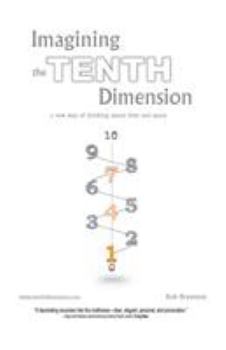
Paperback Imagining the Tenth Dimension: A New Way of Thinking about Time and Space Book

ISBN: 1425103804

ISBN13: 9781425103804

Imagining the Tenth Dimension: A New Way of Thinking about Time and Space

Select Format

Select Condition ThriftBooks Help Icon

Recommended

Format: Paperback

Condition: Very Good

$9.79
Save $11.91!
List Price $21.70
Almost Gone, Only 1 Left!

Book Overview

Reality, today's physicists tell us, is created by the vibrations of exquisitely tiny superstrings in ten spatial dimensions. Ten dimensions? Most of us have barely gotten used to the idea that there are four.

Using simple geometry and an easygoing writing style, author Rob Bryanton starts with the lower dimensions that we are all familiar with, then uses those concepts to build one layer upon another, ultimately arriving at a way of imagining the tenth dimension.

Part scientific exploration, part philosophy, this unique book touches upon such diverse topics as dark matter, Feynman's "sum over paths", the quantum observer, and the soul. It is aimed at anyone interested in leading-edge theories about cosmology and the nature of reality, but it is not about mainstream physics. Rather, Imagining the Tenth Dimension is a mind-expanding exercise that could change the way you view this incredible universe in which we live.

Customer Reviews

5 ratings

A complex subject handled by a master of perception.

For at least 10 years Rob Bryanton has been pondering the implications of the latest scientific theories of quantum mechanics. How can ordinary mortals understand and visualise what a 10-dimensional universe is? You would think its impossible. This book goes a long way to achieving the impossible. It is supported by numerous vlogs that the author has uploaded to his web site and to YouTube. Good job Rob!

Keyword here is "imagining"...

I enjoyed this book a great deal, but I think it's important to keep in mind that it is about imagining and visualizing things, and not about mathematical representations. I see a lot of reviews of it here that complain about the lack of scientific rigour, but the author himself would be the first to tell you that the book is not a precise scientific treatment. With that said, it is also an extremely thoughtful description of some of the possibilities that emerge from the many-worlds interpretation of quantum mechanics, and I think if you dismiss it because the mapping to the mathematical concept of dimension is too direct for you, you are missing something worth reading and thinking about. I'm a reasonably well-read amateur in the fields of physics and math, and I do not think the way he describes dimensions is completely out of whack with how the world might really work. Neither the book nor I endorse the "anything could happen at any time for no reason" idea, or tries hard to tie quantum concepts to religion, but rather it explores how it is that the things that do actually happen could come to be. Reality is a very strange thing, and I think that any physicist who claims to have grasped what it is, exactly, is deluding themself. That doesn't mean we cannot know what it is, that it is an eternal mystery, though parts of it may turn out to be that; but that we do not at present know everything about it. So, back to the book. As I say in the title: the keyword here is "imagining". This book is as much a trip through philosophy, consciousness and reality using the familiar concepts of dimension as it is an attempt to explain the dimensions themselves. But the insight into dimension as "a way of varying" that is consistently put forward through the book ought to be interesting to anyone. It frequently helps in all kinds of fields to look at things in terms of a finite-dimensional space containing a dynamic system. The better you can map the concept of variation to dimension, the easier you will find that kind of thing. If you have a particularly visual imagination, you'll find it a good time. If you enjoy science-fiction that speculates about the deep nature of reality, you'll enjoy it. If you're looking for a textbook on quantum physics, this is not it, and the author tells you so himself.

Mapping a framework for the big picture

Higher dimensions, many worlds, parallel universes, multidimensionality, non-locality - these and similar terms are variously invoked in relativity, quantum mechanics, mathematics, religion, science fiction, paranormal phenomena, meditation and drug experiences. Higher dimensions range from being complex mathematical constructs to non-quantifiable experiential phenomena. But for the average person (and most likely, many professional scientists), there is a need to know the answer to the type of query once posed by Woody Allen: "There is no question that there is an unseen world. The problem is, how far is it from midtown and how late is it open?" That is, we want to know what are the characteristics of the higher dimensions, how do they differ, what are the implications of their existence, is there a logic to the definition of such dimensions? These types of questions have nagged at me for over thirty years. Everything I read only nibbled at the edges or indulged in esoterica. Then I stumbled onto Rob Bryanton's Imagining the Tenth Dimension: A New Way of Thinking About Time and Space. In an easily readable style he has boldly taken us past the fourth dimension through to the tenth employing an understandable logic based on geometric considerations. There is no mind-boggling mathematics and there is a distinct absence of the crank/crackpot style; each step along the way is carefully developed in a sequential manner accompanied by readily understandable diagrams. Again, without being too technical, he correlates properties of the unfolding dimensions with predictions and outcomes of modern physics, especially quantum mechanics. Philosophical implications are explored along the way. Imagining the Tenth Dimension: A New Way of Thinking About Time and Space has at long last provided a framework in which the bigger picture, for me at least, makes intuitive and scientific sense. Stick with the logic and you too should be rewarded with an "Ahah!" experience. I felt the dots were joined and the gaps filled in my own personal ponderings on higher dimensions and the sense of satisfaction was not just restricted to the scientific side of me. My background is in the physical sciences and having read the book twice, I am yet to find any weaknesses in the proposals. For the more mathematically and physics-minded amongst you, the challenge is to subject Rob Bryanton's ideas to scrutiny - he has an excellent blog site for such feedback and discussion.

You will not be disappointed !!!!

Imagining the Tenth Dimension is a wonderful book that helped me thinking "outside of the box" and taught me many complex concepts in a fun and easy to understand way. Bryanton way of thinking is easy follow and his explanations make a lot of sense to to scientists, philosophers and to the average reader alike. I highly recommend this book to anyone that is interested in learning about some of the most complex concepts in modern science in a fun and revolutionary way. You will not be disappointed.

Imagination is Good

There are times when those in academia are right to be critical of poorly conceived ideas but there are also times when such criticism only inhibits new ways of seeing. This book conveys a very different and unique way of looking at the universe. The author doesn't assume pre-existent dimensions of height, width, depth, and time, only an indefinable point that evolves into curved spaces, creating a model of dimensions that really should remind the reader that the physical universe we observe is known to be a curved space-time and not a box of space. As one sees from the popular video associated with this book, the way Bryanton builds up dimensions into a multiverse is quite intriguing, certainly worthy of cataloging. Many people in academia initially shy away from this kind of new approach, but the way the dimensions expand then fold back inward into an indefinite point is consistent with holographic enfoldment ideas from people such as the famous physicist David Bohm and science writer Micheal Talbot. Whether taken seriously by a student of science or not, the method of synthesizing every concievable universe into a final tenth dimension weilds considerable strength.
Copyright © 2025 Thriftbooks.com Terms of Use | Privacy Policy | Do Not Sell/Share My Personal Information | Cookie Policy | Cookie Preferences | Accessibility Statement
ThriftBooks ® and the ThriftBooks ® logo are registered trademarks of Thrift Books Global, LLC

GoDaddy Verified and Secured