


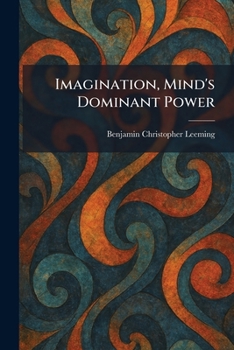
Imagination, Mind's Dominant Power

Select Format
Select Condition 
Book Overview
"Imagination, Mind's Dominant Power" is a compelling exploration into the profound influence of the human imagination on personal achievement and mental health. Written by Benjamin Christopher Leeming, this work argues that imagination is not merely a luxury of the artist, but the fundamental engine driving all human activity. By examining the psychology of thought and the mechanics of the mind, Leeming demonstrates how mental images dictate our emotions, habits, and physical actions.
The text serves as both a philosophical treatise and a practical guide for self-mastery. It delves into the relationship between the conscious and subconscious mind, illustrating how focused visualization can be used to overcome obstacles and manifest one's goals. Leeming posits that by understanding the dominant power of the mind, individuals can transition from being passive victims of circumstance to active creators of their own destiny. This work is a significant contribution to the early 20th-century movement of personal development and remains a vital resource for those interested in the transformative potential of cognitive focus. "Imagination, Mind's Dominant Power" offers a timeless perspective on how our internal vision shapes our external world, emphasizing the importance of mental discipline and creative thought.
This work has been selected by scholars as being culturally important, and is part of the knowledge base of civilization as we know it. This work was reproduced from the original artifact, and remains as true to the original work as possible. Therefore, you may see the original copyright references, library stamps (as most of these works have been housed in our most important libraries around the world), and other notations in the work.
This work is in the public domain in the United States of America, and possibly other nations. Within the United States, you may freely copy and distribute this work, as no entity (individual or corporate) has a copyright on the body of the work.
As a reproduction of a historical artifact, this work may contain missing or blurred pages, poor pictures, errant marks, etc. Scholars believe, and we concur, that this work is important enough to be preserved, reproduced, and made generally available to the public. We appreciate your support of the preservation process, and thank you for being an important part of keeping this knowledge alive and relevant.
Customer Reviews
ThriftBooks ® and the ThriftBooks ® logo are registered trademarks of Thrift Books Global, LLC
