


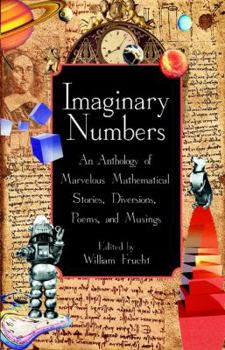
Imaginary Numbers: An Anthology of Marvelous Mathematical Stories, Diversions, Poems, and Musings

Select Format
Select Condition 
Book Overview
"With this delightful anthology, Frucht throws a bridge across the chasm separating the 'Two Cultures' of science and literature."--Booklist "A marvelous colledtion of diverse talents and writing."--San Diego Union-Tribune A wildly inventive treasury of the most artful words ever written about numbers. Mathematics and writing may seem to exist in opposite realms, but as William Frucht reveals, the world of numbers has always held a special fascination for men and women of letters. Imaginary Numbers displays the fruits of this cross-fertilization by collecting the best creative writing about mathematical topics from the past hundred years. In this engaging anthology, we can explore the many ways writers have played with mathematical ideas. Delve into the fourth dimension and infinity, into fantasy and philosophy with such masters as Lewis Carroll, Edwin Abbott Abbott, Philip K. Dick, Martin Gardner, and Alan Lightman. Revel in renowned tales by Italo Calvino and Jorge Luis Borges, cult classics such as Connie Willis's "The Schwartzschild Radius,"and lesser-known gems by such visionaries as William Gibson and A. K. Dewdney. For mathematical mavens and literary lions alike, Imaginary Numbers adds up to one fascinating read.
Format:Hardcover
Language:English
ISBN:0471332445
ISBN13:9780471332442
Release Date:September 1999
Publisher:Wiley
Length:352 Pages
Weight:1.28 lbs.
Dimensions:8.9" x 1.1" x 5.8"
Customer Reviews
5 ratings
Worthy Successor...
Published by Thriftbooks.com User , 17 years ago
It was a pleasant surprise to discover this book. Its description reminded me of Martin Gardner's Fantasia Mathematica and its sequel, The Mathematical Magpie. In fact that is exactly, deliciously, what William Frucht has given us. In an afterward, he tells how he begged Gardner to put together a new mathematical fantasia. Gardner finally suggests that Frucht put it together himself! Gardner's original anthology is one of my favorite anthologies of all time, and Frucht's successor is satisfyingly worthy. Three cheers for Frucht! Now if only there were sequels to the sequels...one sequel in the first square of a giant chessboard, two in the second, four in the third, eight in the fourth...ah, yes...what a beautiful thought, albeit a tad mite greedy...but like Stanislaw Lem's theoretical dragons, maybe the theoretical sequels to the sequels could sometimes be partially real...
I Can't Recommend it Enough
Published by Thriftbooks.com User , 17 years ago
My parents bought this for me right when it came out I guess, which means I was about 14 at the time. Looking back, I've realized just how much the stories here influenced me. Burning Chrome is still one of my favorite stories, and there's a little-known PKD gem called the Golden Man that brings up all sorts of ideas about intelligence and evolution. It's not all dark stories, but they're the most memorable to me. Especially two of them which have a unique take on the horrors of war, Schwartzchild Radius and The Private War of Private Jacob. I need to dig this book up again. Make sure you do too.
For Anthology Lovers
Published by Thriftbooks.com User , 24 years ago
This book is undoubtedly "An Anthology of Marvelous Mathematical Stories, Diversions, Poems, and Musings." This collection of works spans a broad field of all types of literary genres: from fantacy to philosophy, from sci-fi to logic, from wonderfully outrageous to profoundly simple. Anyone with a taste for short stories and poetry will be able to appreciate the thought-provoking material presented in this anthology. For instance, one can learn what life would be like in a two-dimentional universe. Or one can travel to a land where improbable dragons become probable and pop into existance out of thin air. And one can ponder the similarities between love and parallel lines. I found this book to be at times funny and also serious. It has something for everyone. Enjoy.
Mathematics in unusual places
Published by Thriftbooks.com User , 25 years ago
Mathematics can be a part of fiction in many ways, and this collection has some of the most unusual that I have ever read. However, it is unusual in the delightful rather than distasteful sense. As a fan of science fiction, I have always found the inclusion of mathematics in fiction to be some of the best written of all the stories I have read. I found these stories, all previously published, to be entertaining and often very subtle in the points that were made. Some of the stories are classics. There is an excerpt from Flatland by Edwin Abbott Abbott, what I believe to be the best piece of mathematical fiction ever written and a piece by Martin Gardner, the best mathematical populist that has ever lived. Stanislaw Lem's story about the hotel with a countably infinite number of rooms is one of the best expositions of the apparent paradoxes of the countably infinite set that has ever been created. It could be used as a textbook example to explain this often difficult point. If you like fiction with a point to make based on applications of some serious science, then you will find these stories well worth reading. Published in Journal of Recreational Mathematics, reprinted with permission.
A dash of elegance science fictions
Published by Thriftbooks.com User , 25 years ago
This book is a good starting point for the journey to the 'dark' science-philosophical-fiction reading. Featuring from Lewis Carroll's work to Italo Calvino, it provides a wide range of mathematical-fiction and poetry collection (ie. how love can be so similar to parallel lines). A definite must, especially for mathematician!
Copyright © 2026 Thriftbooks.com Terms of Use
| Privacy Policy | Do Not
Sell/Share My Personal Information | Cookie Policy | Cookie Preferences | Accessibility Statement
ThriftBooks® and the ThriftBooks® logo are registered trademarks of Thrift Books Global, LLC
ThriftBooks® and the ThriftBooks® logo are registered trademarks of Thrift Books Global, LLC
