


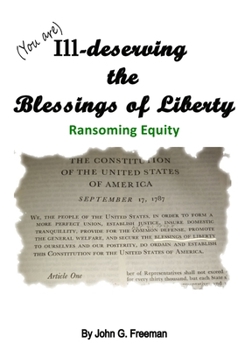
Ill-deserving the Blessings of Liberty: Ransoming Equity

Ill-deserving the Blessings of Liberty: Ransoming Equity by John G. Freeman is a thought-provoking examination of justice, equity, illness, and the responsibilities of institutions that hold power over people's lives. Drawing from philosophy, history, constitutional principles, personal experience, and extensive research, Freeman argues that society too often fails its most vulnerable members, particularly those affected by serious illness.
Combining a critique of the justice system with a detailed account of the author's own vulnerabilities from autoimmune encephalitis, the book explores how legal, medical, and employment systems unintentionally or deliberately compound human suffering. Freeman challenges readers to reconsider long-held assumptions about responsibility, punishment, due process, and individual rights, while advocating for a justice system grounded in humility, accountability, and equity.
Through discussions of thinkers ranging from Herodotus, Plato, and Aristotle to the framers of the United States Constitution, the author traces a centuries-long pursuit of fairness, shows the United States Constitution's answer, and examines how modern institutions can lose sight of their purpose when authority is exercised without compassion or restraint.
Part legal commentary, part philosophical inquiry, and part personal narrative, Ill-deserving the Blessings of Liberty is a passionate call to protect individual liberty, uphold human dignity, and ensure that those entrusted with power never forget the people they serve.
A central theme of the book is the constitutional and moral imperative that equity is law. Freeman argues that equity is not a discretionary addition to legal processes, but a foundational mandate embedded in the U.S. Constitution and the very definition of justice. He demonstrates, through historical and legal analysis, that justice without equity is incomplete and inevitably unjust, and that every individual-especially the ill and vulnerable-must be treated with fairness and individualized consideration as a matter of law.
The book is structured with a mix of personal medical records, philosophical insights, and practical advice. Freeman explores the obstacles faced in seeking proper medical care, the dangers of workplace neglect, and the devastating impact of being misunderstood or mishandled by legal authorities. He draws on lessons from history and the U.S. Constitution to argue that true justice and liberty require not only the traditional form of laws, but also legally mandated empathy, accountability, and a commitment to equity for every individual.
Another unique feature of this book is its suggested metric for medical care quality control. Freeman introduces an objective framework for measuring and improving patient care, emphasizing the importance of timely action, provider willingness, and accountability at every stage of the healthcare process. His proposed NO*WAIT system offers practical tools for healthcare organizations to track progress, identify gaps, and ensure that patients receive the needed attention and solutions. This approach is especially valuable for those with rare or complex conditions, where delays and miscommunication can have life-altering consequences.
Ill-deserving the Blessings of Liberty is essential reading for patients, healthcare professionals, legal advocates, and policymakers. It offers a rare, firsthand perspective on the intersection of illness and institutional power, and it urges readers to recognize and correct the injustices that persist in our most critical systems.
Customer Reviews
ThriftBooks ® and the ThriftBooks ® logo are registered trademarks of Thrift Books Global, LLC
