


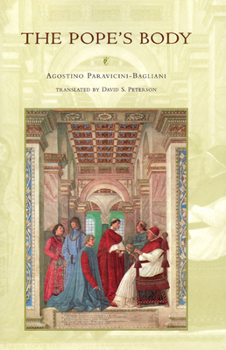
The Pope's Body

In contrast to the role traditionally fulfilled by secular rulers, the pope has been perceived as an individual person existing in a body subject to decay and death, yet at the same time a corporeal representation of Christ and the Church, eternity and salvation. Using an array of evidence from the eleventh through the fifteenth centuries, Agostino Paravicini- Bagliani addresses this paradox. He studies the rituals, metaphors, and images of the pope's body as they developed over time and shows how they resulted in the expectation that the pope's body be simultaneously physical and metaphorical. Also included is a particular emphasis on the thirteenth century when, during the pontificate of Boniface VIII (1294-1303), the papal court became the focus of medicine and the natural sciences as physicians devised ways to protect the pope's health and prolong his life. Masterfully translated from the Italian, this engaging history of the pope's body provides a new perspective for readers to understand the papacy, both historically and in our own time.
Format:Hardcover
Language:English
ISBN:0226034372
ISBN13:9780226034379
Release Date:July 2000
Publisher:University of Chicago Press
Length:352 Pages
Weight:1.25 lbs.
Dimensions:1.1" x 5.9" x 9.3"
Customer Reviews
1 rating
Ubi Papa, ibi Roma
Published by Thriftbooks.com User , 21 years ago
While the Pope is alive, he is the Vicar of Christ and in many ways in the embodiment of the church in the world. When the Pope dies, his body becomes an object of veneration for the faithful - most popes (somewhat ironically) have not gone on to be canonised as saints, but even so, the days of official mourning, the masses, the lying in state for the faithful to witness, other traditional aspects attest to the importance of not just the person, but the physical body of the pope. Given the general Catholic sense about the sanctity of life (however much it might have been violated in actual practice throughout history), the efforts extended toward protection and preservation of the pope's life is paramount. There has been a sense among world leaders that they are in themselves the embodiment and symbol of the peoples or nations they lead. King Louis's statement of the state, 'C'est moi!'; Elizabeth's pronouncement that she WAS England; even the substantial identification of the Roman Emperor with the Empire (being of one substance, co-equal, etc., which sounds awfully like the creeds recited in the church) - these are all tapping into the same idea that the Pope taps into when it is said, 'Ubi Papa, ibi Roma', where the Pope is, there is Rome. Given the current situation with Pope John Paul II, this book in its second section is undoubtedly of interest - it describes the various rituals and practices that take place at the time of the Pope's death; this includes the protection of the papal apartments, what becomes of the papal wardrobe and personal effects, the funeral rites, the burial practices, and the various election features that follow. Paravicini-Bagliani does address the issues that occur should a pope be displaced (not all have remained pope until death). The third section looks at practical matters - the Pope is a human being, after all, with the same bodily needs and functions as any other man. During the thirteenth century, and for some time after, the Vatican became quite the scientific enclave, with research into medicine and physical health issues designed at enhancing the Pope's ability to function, and extending his life if necessary. One of the features of most popes' lives has been the brevity of their tenure. This was known from the earliest days, with speculation in the mid-1000s (nearing the millennium-mark after Peter's death) that no pope's tenure should or could last longer than that of St. Peter (whose tenure is thought to have been about 25 years; the current Pope, John Paul II, has bested that term, becoming the third-longest reigning pope in history). Paravicini-Bagliani describes the pope as being no mere earthly ruler, however; when kings and other sovereigns die, their administration continues, but when a pope dies, 'the world loses a father', and the whole functioning of the Vatican stops. This is a timely work, interesting not just because of the current situation facing the church, but also
Copyright © 2026 Thriftbooks.com Terms of Use
| Privacy Policy | Do Not
Sell/Share My Personal Information | Cookie Policy | Cookie Preferences | Accessibility Statement
ThriftBooks® and the ThriftBooks® logo are registered trademarks of Thrift Books Global, LLC
ThriftBooks® and the ThriftBooks® logo are registered trademarks of Thrift Books Global, LLC
