


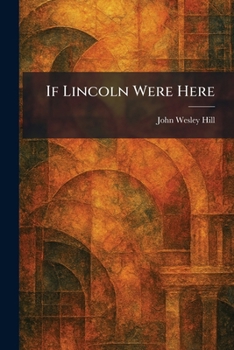
If Lincoln Were Here

Select Format
Select Condition 
Book Overview
"If Lincoln Were Here" is a profound exploration of the enduring legacy and political philosophy of Abraham Lincoln. In this compelling work, John Wesley Hill examines how the principles of the Great Emancipator might be applied to the complex social, economic, and political challenges of a changing world. Rather than a mere historical biography, the text serves as a roadmap for American citizenship, emphasizing the virtues of moderation, justice, and national unity that defined Lincoln's presidency.
Through a series of analytical reflections, Hill discusses Lincoln's views on labor and capital, his unwavering commitment to the Constitution, and his belief in the inherent dignity of the individual. The author argues that Lincoln's spirit offers a vital antidote to the radicalism and discord of the modern era. By invoking the memory of one of America's most revered leaders, Hill seeks to inspire a renewed sense of patriotism and civic responsibility. This work remains a significant contribution to the study of Lincoln's influence on American thought and a testament to the timeless nature of his wisdom.
This work has been selected by scholars as being culturally important, and is part of the knowledge base of civilization as we know it. This work was reproduced from the original artifact, and remains as true to the original work as possible. Therefore, you may see the original copyright references, library stamps (as most of these works have been housed in our most important libraries around the world), and other notations in the work.
This work is in the public domain in the United States of America, and possibly other nations. Within the United States, you may freely copy and distribute this work, as no entity (individual or corporate) has a copyright on the body of the work.
As a reproduction of a historical artifact, this work may contain missing or blurred pages, poor pictures, errant marks, etc. Scholars believe, and we concur, that this work is important enough to be preserved, reproduced, and made generally available to the public. We appreciate your support of the preservation process, and thank you for being an important part of keeping this knowledge alive and relevant.
Customer Reviews
ThriftBooks ® and the ThriftBooks ® logo are registered trademarks of Thrift Books Global, LLC
