


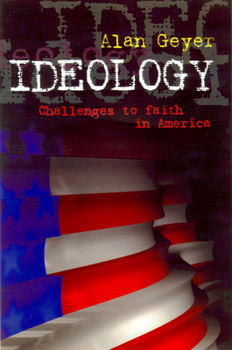
Ideology in America: Challenges to Faith


Select Format
Select Condition 
Book Overview
In this prophetic and inspiring call to justice, peace, and economic democracy, Alan Geyer proposes strategies for mainline churches and ecumenical institutions to counter the assault of damaging... This description may be from another edition of this product.
Format:Paperback
Language:English
ISBN:0664256333
ISBN13:9780664256333
Release Date:May 1997
Publisher:Westminster John Knox Press
Length:139 Pages
Weight:0.57 lbs.
Dimensions:0.5" x 6.0" x 9.0"
Customer Reviews
1 rating
Ethical Challenges and Intellectual Poverty in Modern America
Published by Thriftbooks.com User , 16 years ago
Geyer is an ethicist who here analyzes the ethics of current political processes in American society. He defines moral challenges for the Christian church in the United States, and makes some suggestions on how the church can address the political situation while maintaining its independent integrity and morality based on faith. Historical Foundations The publisher's notes describe the book this way: "A foremost ethicist challenges conservative ideologies." The author presents a summary of ideologies affecting the United States through its history. This will be valuable for the younger generation to understand the roots of the philosophical questions being dealt with. Cultural Poverty There is a tendency for each new generation to begin in a vacuum. I have noticed a cultural poverty of historical perspective in the current American generation. There seems to be less attention in American education to the cultural history. Younger Americans are not given a view of the intellectual foundations that initially formed this country. This has led to much revisionism in the last two decades of popular thought. This is a rewriting of history to match current concepts. A romantic interpretation is given to the early stages of the American experiment usually ignoring the complexities and conflicts involved in the attempt to overcome the political aned religious tyranny over men's minds and beliefs. This appears notably in the astounding claim made amazingly by supposedly conservative religious leaders in America that America's founders had no concept of Separation of Church and State. Only a gratuitous misreading of founding documents and the prolific philosophies of the era could allow someone to make such a claim. And yet somehow proponents call this argument "conservative"! Confused Argument Personal and institutional religion appears to be confused in modern American society. Arguments on the topic of the separation of official church and state have become confused with questions about the public expression of personal religious convictions. Geyer discusses the principles involved here. The new use of government power to restrict personal expression of religious beliefs indicates a confusion over the separation of formal church and state institutions with the private expression of religious views in the public arena, which is specifically protected by the constitution. The original desire to prevent official church institutions from controlling government power, as was the common state in Europe in the 1700s, has now been extended to limit the personal rights of individuals in the public arena, which is a whole separate question in American culture and constitutional politics. Some religious advocates have likewise tried to impose their personal or denominational views on others by use of state mechanisms to impose their views as "official" or public policy, on the basis that America has always been a "Christian nation." But this has
Copyright © 2026 Thriftbooks.com Terms of Use
| Privacy Policy | Do Not
Sell/Share My Personal Information | Cookie Policy | Cookie Preferences | Accessibility Statement
ThriftBooks® and the ThriftBooks® logo are registered trademarks of Thrift Books Global, LLC
ThriftBooks® and the ThriftBooks® logo are registered trademarks of Thrift Books Global, LLC
