


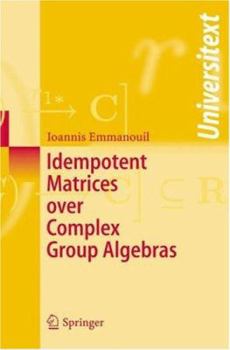
Idempotent Matrices Over Complex Group Algebras
No Customer Reviews

The study of idempotent elements in group algebras (or, more generally, the study of classes in the K-theory of such algebras) originates from geometric and analytic considerations. For example, C.T.C. Wall 72] has shown that the problem of deciding whether a ?nitely dominated space with fundamental group? is homotopy equivalent to a ?nite CW-complex leads naturally to the study of a certain class in the reduced K-theoryK (Z?) of the group ringZ'. 0 As another example, consider a discrete groupG which acts freely, properly discontinuously, cocompactly and isometrically on a Riemannian manifold. Then, following A. Connes and H. Moscovici 16], the index of an invariant 0th-order elliptic pseudo-di'erential operator is de'ned as an element in the ? ? K -group of the reduced groupC -algebraCG. 0 r Theidempotentconjecture(alsoknownasthegeneralizedKadisonconjec- ? ? ture) asserts that the reduced groupC -algebraCG of a discrete torsion-free r groupG has no idempotents =0,1; this claim is known to be a consequence of a far-reaching conjecture of P. Baum and A. Connes 6]. Alternatively, one mayapproachtheidempotentconjectureasanassertionabouttheconnect- ness of a non-commutative space;ifG is a discrete torsion-free abelian group ? thenCG is the algebra of continuous complex-valued functions on the dual r
Format:Paperback
Language:English
ISBN:3540279903
ISBN13:9783540279907
Release Date:October 2005
Publisher:Springer
Length:282 Pages
Weight:0.98 lbs.
Dimensions:0.7" x 9.3" x 6.2"
Customer Reviews
0 rating
Copyright © 2026 Thriftbooks.com
Terms of Use | Privacy Policy | Do Not Sell/Share My Personal Information | Cookie Policy | Cookie Preferences | Accessibility Statement
ThriftBooks ® and the ThriftBooks ® logo are registered trademarks of Thrift Books Global, LLC
ThriftBooks ® and the ThriftBooks ® logo are registered trademarks of Thrift Books Global, LLC
