


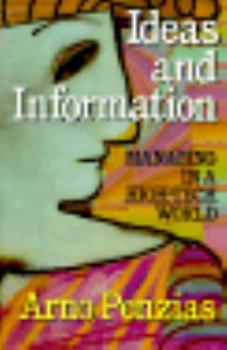
Ideas and Information: Managing in a High-Tech World


Select Format
Select Condition 
Book Overview
In one human generation, the world's work has moved from muscle to machines that move information rather than goods. Driving the information revolution is the computer, a machine of unquestioned power but questionable intelligence. Arno Penzias, whose Bell Laboratories stands at the center of electronic innovation, explores here the relationship of human beings to the new electronic world.
Format:Hardcover
Language:English
ISBN:0393026493
ISBN13:9780393026498
Release Date:January 1989
Publisher:W. W. Norton & Company, Inc.
Length:224 Pages
Weight:1.00 lbs.
Dimensions:8.8" x 1.0" x 5.8"
Related Subjects
Business Business & Investing Business & Management Computers Computers & Technology Culture Economics Engineering Industrial, Manufacturing & Operational Systems Management Management & Leadership Manager's Guides to Computing Mathematics Politics & Social Sciences Science Science & Math Science & Scientists Science & Technology Social Science Social Sciences TechnologyCustomer Reviews
2 ratings
Ideas and Information.
Published by Thriftbooks.com User , 23 years ago
Inspiration as opposed to instruction. Mind as opposed to machine...Read any physics text or popularization of the past thirty-five years and you are virtually certain to encounter Arno Penzias. He received the Nobel Prize for physics by detecting the cosmic microwave background radiation that George Gamow had predicted two decades earlier. Theorists sometimes suggest that Gamow's Nobel somehow landed accidentally in Penzias' empirical lap. One imagines that Penzias might be tempted to barrow a line from Rodney Dangerfield: "I tell ya, I don't get no respect." He doesn't do that.Anyway, when I spotted this book in a used bookstore I happily nabbed it. The author's theme in this volume is computability -- how it works, what it is, and what it isn't. The book is highly readable and makes for a sound introduction to what computer software is, and to how artificial intelligence and human intelligence are, foundationally, two very different things. The strong AI types don't want to hear this stuff and will likely complain that Penzias' book is "dated." I will say that only the author's examples/ allegories are dated. Technological gadgetry changes quite a bit in 14 years, but the examples are only examples. Programming is still programming; it is still a process of numerical reduction. It is still something far different than human intuition. With a modicum of updates, Penzias' thesis might easily read as a more current set of arguments and observations.Consider this book a springboard into the work of Roger Penrose (uh-oh, you'll be mixing empirical guy and theoretical guy!).Penzias says, "If you don't want to be replaced by a machine, don't act like one." Machines are quite useful, but your mind is not a mere machine. Use it to its strength -- be creative, be non-linear. This empirical guy sounds a lot like a theoretical guy. Somewhere an ardent reductionist is cringing.
Great discussion of estimating information --
Published by Thriftbooks.com User , 24 years ago
I give this book four stars just for the section on estimation -- can you calculate the number of barbers in the United States by using common sense and a few simple assumptions? How about the speed of the Mississippi river? As another reviewer has said, the book is not the most up to date and does not systematically address all aspects of the topic but provides some interesting insights that make it worth a look.
Copyright © 2026 Thriftbooks.com
Terms of Use | Privacy Policy | Do Not Sell/Share My Personal Information | Cookie Notice | Cookie Preferences | Accessibility Statement
ThriftBooks ® and the ThriftBooks ® logo are registered trademarks of Thrift Books Global, LLC
ThriftBooks ® and the ThriftBooks ® logo are registered trademarks of Thrift Books Global, LLC
