


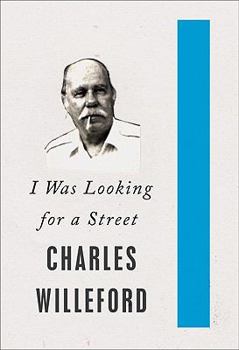
I Was Looking for a Street


Select Format
Select Condition 
Book Overview
"I'm proud to say I knew the man who wrote this book," writes Elmore Leonard of cult crime writer Charles Willeford's moving memoir of his youth. "It is pure writing, never pretentious or forced, never melodramatic, but honest storytelling of the highest order. This is how to do it, if anyone wants to know: how to write simple prose from a young boy's point of view and hold the reader spellbound." "I Was Looking for a Street "tells the story of the author's childhood and adolescence as an orphan, as he moves from railroad yards to hobo tent cities, to soup kitchens and deserts around Los Angeles and across the United States. The ensuing tale is at once a picaresque adventure through Depression-era America and a portrait of the writer as a young man of seemingly little promise but great spirit. Written after Willeford's later literary success with "Cockfighter," "Miami Blues "and "The Woman Chaser," this memoir is the work of a writer at the height of his powers, looking back without nostalgia or regret, and preserving in his clear and powerful prose the great American adventure of his youth. "I Was Looking for a Street" is the first in a series of PictureBox reissues of the work of Willeford, who today counts writer Luc Sante (who contributes a preface to this volume), director Quentin Tarantino and musician Will Oldham among his many devoted fans.A former professional boxer, actor, horse trainer and radio announcer, Charles Willeford (1919-1988) is best known for his crime fiction featuring hardboiled detective Hoke Moseley. His career as a writer began in the late 1940s, but it was his 1962 novel "Cockfighter" that announced his name to a wider audience. His three best-known novels have all been adapted for the screen: Monte Hellman's 1974 "Cockfighter," George Armitage's 1990 "Miami Blues "(starring Alec Baldwin) and Robinson Devor's 1999 "The Woman Chaser."
Format:Paperback
Language:English
ISBN:0982094779
ISBN13:9780982094778
Release Date:April 2010
Publisher:Picturebox, Inc.
Length:152 Pages
Weight:0.56 lbs.
Dimensions:0.5" x 5.1" x 7.9"
Customer Reviews
3 ratings
Entertaining tale
Published by Thriftbooks.com User , 16 years ago
This is not a bad book at all. It is the story of Charles Willeford, the clever creator of the Hoke Moseley crime series, when he was riding the rails (living on the road and catching trains by hopping onto them as they moved) as an early teen (about 12-14). It is not a long book (about 140 pages) and worth the time reading about the authors experiences in the Great Depression. If I had to nitpick, it would be that the writer doesn't really tell attention grabbing stories, they are ok but not the kind of stories that you remember after the book is finished.
Haven't read Willeford? What are you waiting for?!
Published by Thriftbooks.com User , 16 years ago
Charles Willeford was America's finest writer of crime fiction -- and other kinds of fiction. If you haven't read Willeford yet, what are you waiting for? Quick -- drop that latest piece of trash about a Vatican conspiracy involving Italian Renaissance painters and frozen alien fossils or whatever -- and track down one or more of the following: "The High Priest of California", "Wild Wives", "The Black Mass of Brother Springer", "The Woman Chaser", "Cockfighter", "The Burnt Orange Heresy", "Miami Blues", "New Hope for the Dead", "Sideswipe", "The Way We Die Now", "Kiss Your A-- Good-bye", "The Shark-Infested Custard", or anything else by Willeford, including the above autobiographical title, "I Was Looking for a Street". Though most of Willeford's work could be classified as crime fiction, two of his finest novels ("High Priest of California", "Cockfighter") don't really focus on crime at all. Some writers use too much dialogue, others use too much description. Willeford strikes a perfect balance -- before you get past the first page, you know you're in for a great read. Willeford demonstrates what great writing is: great plots, characters, dialogue, prose style -- and you get to learn all kinds of valuable information about things like the used car business and art criticism.
The making of an iconoclast.
Published by Thriftbooks.com User , 20 years ago
In I Was Looking for a Street, Charles Willeford (1919-1988) tells in straightforward fashion what his early life was like. Orphaned by age 8 and a rail riding drifter by age 13, Willeford's childhood was a tough one. But there isn't an ounce of bitterness in this memoir. Instead of cursing his misfortune, Willeford sees each setback he endured, no matter how terrible, as a learning experience. With a minimal amount of sentimentality, Willeford tells how the middle class life he was born into rapidly evaporated when tuberculosis claimed both his parents and, a few years later, the Great Depression thrust his beloved grandmother Mattie into poverty. He goes on to compellingly describe his life as a "road kid" among the hobos and tramps who hopped freight trains in a never ending journey to absolutely nowhere. Fans of Willeford's novels and short stories will definitely want to read this short but amazing autobiography. Told with the author's trademark matter-of-fact style, the anecdotes contained in I Was Looking for a Street are quite interesting and reveal a lot about the origins of Willeford's unique worldview. Highly recommended.
Copyright © 2026 Thriftbooks.com
Terms of Use | Privacy Policy | Do Not Sell/Share My Personal Information | Cookie Policy | Cookie Preferences | Accessibility Statement
ThriftBooks ® and the ThriftBooks ® logo are registered trademarks of Thrift Books Global, LLC
ThriftBooks ® and the ThriftBooks ® logo are registered trademarks of Thrift Books Global, LLC
