


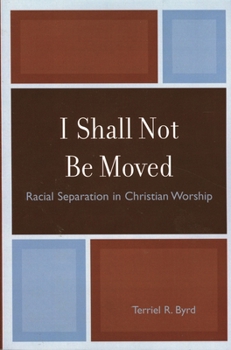
I Shall Not Be Moved: Racial Separation in Christian Worship

This work examines the ongoing perceptions and ill-conceived notions of both Black and White Christians, as it relates to tradition and familial worship habits, the understanding of sacred and secular domains, and the role that color and culture play in the separation of religious worshippers. I Shall Not Be Moved challenges the reader to examine the issue presented based upon a biblical mandate for unity and love within the body of Christ. Taking into consideration today's multiethnic, multiracial, and otherwise diverse national demographics the church still exists primarily along the color and cultural divide. This divide is deeply rooted in American religious history, culture, and tradition. Ultimately, the question Professor Terriel R. Byrd seeks to answer in this work is: Does this separation hinder the Christian teachings of inclusion and unity?
Format:Paperback
Language:English
ISBN:0761837159
ISBN13:9780761837152
Release Date:June 2007
Publisher:University Press of America
Length:96 Pages
Weight:0.35 lbs.
Dimensions:0.3" x 6.3" x 9.0"
Customer Reviews
4 ratings
Tackling a long neglected subject
Published by Thriftbooks.com User , 18 years ago
In this provocative little book Terriel Byrd attempts to answer the question of how and why? -- even after the incredible gains of the civil rights movement -- that in the words of Martin Luther King, Jr. "Eleven o'clock Sunday morning is still America's most segregated hour, and the Sunday school is the most segregated school of the week." He compellingly lays out the origins and history of racial separation in the American Church starting from colonial times. I was surprised to learn that early on in the colonies it was common for blacks and whites to worship together. It was only as slavery became entrenched that a distinct "white church" and "black church" arose. Byrd writes: "Slavery, it's shameful facts, its historical, social and economic inequalities, its damaging impact on the souls and on the psyches of black people, gave birth to the independent black church. Each of these influences was a dominant factor in the rise of sustained institutionalized separate worship communities." It's a shameful fact that many of our denominational histories can be traced back to the evil of slavery. Just in recent years we've seen denominational leaders struggling to come to terms with this legacy. Yet the separation by and large continues, and as Byrd points out, most Christians have come to accept it as the norm. In the chapter Sacred, Secular or Merely Sinful, he makes the argument that it's not normal and in fact is a scandal on the church's witness to the world. "Unless the epochal distinction of black Christian and white Christian is buried, and with it the racial strife that has permeated the history of the Church in America, the light of Christ's life and the suffering of His cross will continue to be obscured, buried with each service that is gathered in his name. To do anything less would be neither sacred, nor secular; it would be, merely sinful." One of the most interesting sections of the book was the author's recounting of a classroom project in which he sent students on field trips to worship services outside their own racial/cultural context. The experiences were overwhelmingly positive, yet none of the students seriously considered making it a regular practice. Last year when my wife and I were looking for a new church home, we worshiped several times at a local church where we were virtually the only white people in attendance. We were welcomed with open arms and loved the service, yet like those students, never seriously considered joining that church. Perhaps it just seemed like too radical and strange a thing to do for a young, white couple like us to join a historically African-American church. But maybe it's going to take radical forays outside our comfort zones to break down barriers too long left unchallenged. Byrd quotes L. Venchal Booth, founder of the Progressive National Baptist Convention, "the white church needs to become more black and the black church needs to become more white. That's the simple way to put i
I Shall Not be Moved
Published by Thriftbooks.com User , 18 years ago
The Author did well at identifying and detailing the historical accounts and events that gave way to today's separatism in Christian Worship. As an Afro American member of a predominately white church, the book substantiated the reverse separatism I experience Sunday after Sunday. The book was a spiritual inspiration to Love as Christ Loves and to allow that love to permeate beyond tradition, ethnicity, or ritualism. Most importantly, the book is a call for Unity in Worship, a call to move beyond the norm or status quo.
Timely message
Published by Thriftbooks.com User , 18 years ago
Dr. Byrd challenges the segregated church in America as deviant to the model of the church presented in the New Testament. If his challenge were fully accepted, the pervasive racism in our society would be eradicated beginning within the churches, which is where so much social change has originated. The author writes not only out of an academic background of teaching at a Christian university, but out of his experience as a pastor of a black church in the inner city. It is this that makes his brief but penetrating book so valuable. He is not writing as a theorist but as a practitioner.
Grassroots Reconciliation by the Church
Published by Thriftbooks.com User , 18 years ago
The book is written in simple, but convinving prose, with some easily managed jargon,that advocates the church, with its phenomenal reach and influence, become the ground floor of racial reconciliation in America. The author suggests that if the Church can overcome its traditional role as safe haven for family traditions and religious customs, it can increase its relevance and leadership influence by becoming social forerunners of racial harmony. I agree that the church has a significant responsibilty to bridge differences in our society and racial differences are chief among those that can and should be championed by the church.
Copyright © 2026 Thriftbooks.com Terms of Use
| Privacy Policy | Do Not
Sell/Share My Personal Information | Cookie Policy | Cookie Preferences | Accessibility Statement
ThriftBooks® and the ThriftBooks® logo are registered trademarks of Thrift Books Global, LLC
ThriftBooks® and the ThriftBooks® logo are registered trademarks of Thrift Books Global, LLC
