


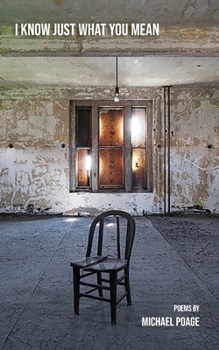
I Know Just How You Feel

"I started reading Michael Poage's I Know Just What You Mean at four in the morning. As it turned out it was a perfect time for espionage. Poem after poem, I began to feel like an agent from some metaphorical intelligence agency. Poage's images took me around the world, Bosnia, Turkey, Gaza. I spied into the hearts of the world's most innocent victims: mother's feeding children, changing diapers, old men marveling at how they've aged in crises, doctor's in hot zones laboring for the welfare of their patients. I found desert and ocean, books disappearing like dreams. Poage writes for those who cannot write for themselves. His poems tell the history of both trauma and hope. We can return to his words in the middle of the night."
-Al Ortolani, author of Controlled Burn and Bull in the Ring
"The great Mexican poet, Octavio Paz, once said this: "In poetry, the world is seen as marvelous." I mention it because it applies to the poems of Michael Poage in his new and 18th ( ) collection, I Know Just What You Mean. The word "marvelous" can mean not only wonderful, but also awe-inspiring or astonishing. These little astonishments show up in a poem like "The Edge," about grandparents taking their toddler grandchild to the sea. The poem ends with a startling pronouncement: we edge away from the dangers of the salt and sea / move inward to the questions of each / estuarial day.
Against these dangers, I Know Just What You Mean balances the marvelous with the stark realities - and horrors - of modern life. Poage goes where American poets too often fear to tread. Poage calls out official criminality. His poems refuse to look away from our recent and ongoing nightmares, the recent and ongoing genocide. He ends Habsora: Gaza, 2023 with an image that is both crushing and unforgivable: the four premature babies are / decomposing in hospital / the small coffins / are the heaviest.
I Know Just What You Mean is an important and essential work by a poet who gives us what we need: the marvelous and the stark truths. They are not incompatible. Rather, they tell the whole story, as recounted by a poet who serves as an acute, a more accurate historian, and a witness to our times. The poet Richard Hugo described the poet's art as "writing one's spiritual autobiography." That's what Michael Poage does in this collection. It's a profound and marvelous accomplishment."
-Ed Harkness
Customer Reviews
ThriftBooks® and the ThriftBooks® logo are registered trademarks of Thrift Books Global, LLC
