




Select Format
Select Condition 
Book Overview
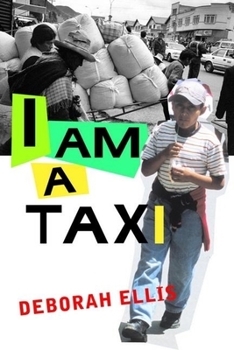
For twelve-year-old Diego and his family, home is the San Sebastian Women s Prison in Cochabamba, Bolivia. His parents farmed coca, a traditional Bolivian medicinal plant, until they got caught in the middle of the government s war on drugs. Diego s adjusted to his new life. His parents are locked up, but he can come and go: to school, to the market to sell his mother s hand-knitted goods, and to work as a taxi, running errands for other prisoners. But then his little sister runs away, earning his mother a heavy fine. The debt and dawning realization of his hopeless situation make him vulnerable to his friend Mando s plan to make big money, fast. Soon, Diego is deep in the jungle, working as a virtual slave in an illegal cocaine operation. As his situation becomes more and more dangerous, he knows he must take a terrible risk if he ever wants to see his family again."
Format:Hardcover
Language:English
ISBN:0888997353
ISBN13:9780888997357
Release Date:August 2006
Publisher:Groundwood Books
Length:176 Pages
Weight:0.70 lbs.
Dimensions:7.8" x 0.8" x 5.3"
Age Range:9 to 12 years
Grade Range:Grades 4 to 9
Customer Reviews
2 ratings
The most interesting book I've read with my kids in the last 12 months
Published by Thriftbooks.com User , 17 years ago
All three of my children commented on this catchy unusual title, expressing doubt that it could possibly be of any interest to them (ages 10, 12, and 14), "What is that? Who checked that out of the library?" Having traveled to Bolivia, I couldn't wait to begin reading it aloud to my youngest before bed. We were not disappointed and I've tossed it to the next child, insisting she read it as she is interested in traveling to South America. The book is quick paced, includes a few Spanish words (Saltenas, Chupe, tc.) and a good glossary for assistance is at the end. Many simple aspects of the Spanish culture were touched on, such as religion (whether the Angel Gabriel will actually come and open the prison doors, lighting church candles) and explaining the Quechua VS Aymara Indians. Descriptive paragraphs of the laundry hanging to dry, bowler hats, merchants in the markets, and more made me envision being back on a village street in Bolivia. Diego is smart, cautious, and asks many questions. There is much emphasis on maintaining composure, loyalty, surviving, and not showing one's fear. I did not interpret any underlying messages, anti-American tones, or otherwise. It is often said in South America, "The bus comes when it comes...." and perhaps, due to my travels through Bolivia and Peru, I have a different attitude of... Life is what it is...and this story about a boy, is what it is - the struggle and challenges of his life. Highly recommend. Tracy Foote Author: Let's Go Up! Climbing Machu Picchu, Putucusi and Huayna Picchu Let's Go Up! Climbing Machu Picchu, Huayna Picchu and Putucusi or A Peru Travel Trip Hiking One of the Seven Wonders of the World: An Inca City Discovered ... the Andes Mountains (Multilingual Edition)
Lived in South America...
Published by Thriftbooks.com User , 19 years ago
This book is an interesting and engrossing read. I'm not certain that younger readers (for which the cover, in particular, seems to be aimed)will "get" it, but the action makes for quite a page-turner, and the subject matter is very thought provoking. The author includes some anti-American and anti-religion undertones which I find a bit annoying, and although she does explain that the cocaine extraction process is different from the coca tea itself, the reader is left cheering for the humble coca farmers. Once again, I hope youthful readers make the distinctions, and that the "bad guy" is cocaine use and not necessarily the U.S. In any case, this book could be a great read-aloud, and I'm looking forward to the sequel.
Copyright © 2026 Thriftbooks.com Terms of Use
| Privacy Policy | Do Not
Sell/Share My Personal Information | Cookie Policy | Cookie Preferences | Accessibility Statement
ThriftBooks® and the ThriftBooks® logo are registered trademarks of Thrift Books Global, LLC
ThriftBooks® and the ThriftBooks® logo are registered trademarks of Thrift Books Global, LLC
