


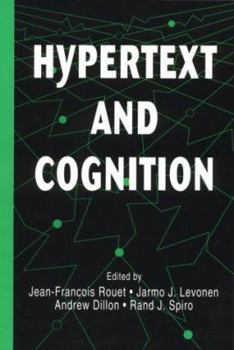
Hypertext and Cognition
No Customer Reviews

Select Format
Select Condition 
Book Overview
The recent evolution of western societies has been characterized by an increasing emphasis on information and communication. As the amount of available information increases, however, the user -- worker, student, citizen -- faces a new problem: selecting and accessing relevant information. More than ever it is crucial to find efficient ways for users to interact with information systems in a way that prevents them from being overwhelmed or simply missing their targets. As a result, hypertext systems have been developed as a means of facilitating the interactions between readers and text. In hypertext, information is organized as a network in which nodes are text chunks (e.g., lists of items, paragraphs, pages) and links are relationships between the nodes (e.g., semantic associations, expansions, definitions, examples -- virtually any kind of relation that can be imagined between two text passages). Unfortunately, the many ways in which these hypertext interfaces can be designed has caused a complexity that extends far beyond the processing abilities of regular users. Therefore, it has become widely recognized that a more rational approach based on a thorough analysis of information users' needs, capacities, capabilities, and skills is needed. This volume seeks to meet that need. From a user-centered perspective -- between systems and users -- this volume presents theoretical and empirical research on the cognitive processes involved in using hypertext. In so doing, it illustrates three main approaches to the design of hypertext systems:
*cognitive, which examines how users process multilayered hypertext structures;
*ergonomical, which explores how users interact with the design characteristics of hardware and software; and
*educational, which studies the learning objectives, frequency and duration of hypertext sessions, type of reading activity, and the user's learning characteristics. This volume also tries to provide answers for the questions that have plagued hypertext research:
*What is hypertext good for?
*Who is hypertext good for?
*If it is useful for learning and instruction, then what type?
*What particular cognitive skills are needed to interact successfully with a hypertext system? Anyone interested in the fields of computer science, linguistics, psychology, education, and graphic design will find this volume intriguing, informative, and a definitive starting point for future research in the field of hypertext.
*cognitive, which examines how users process multilayered hypertext structures;
*ergonomical, which explores how users interact with the design characteristics of hardware and software; and
*educational, which studies the learning objectives, frequency and duration of hypertext sessions, type of reading activity, and the user's learning characteristics. This volume also tries to provide answers for the questions that have plagued hypertext research:
*What is hypertext good for?
*Who is hypertext good for?
*If it is useful for learning and instruction, then what type?
*What particular cognitive skills are needed to interact successfully with a hypertext system? Anyone interested in the fields of computer science, linguistics, psychology, education, and graphic design will find this volume intriguing, informative, and a definitive starting point for future research in the field of hypertext.
Format:Paperback
Language:English
ISBN:0805821449
ISBN13:9780805821444
Release Date:April 1996
Publisher:Routledge
Length:192 Pages
Weight:0.75 lbs.
Dimensions:0.5" x 6.1" x 9.1"
Customer Reviews
0 rating
Copyright © 2026 Thriftbooks.com
Terms of Use | Privacy Policy | Do Not Sell/Share My Personal Information | Cookie Notice | Cookie Preferences | Accessibility Statement
ThriftBooks ® and the ThriftBooks ® logo are registered trademarks of Thrift Books Global, LLC
ThriftBooks ® and the ThriftBooks ® logo are registered trademarks of Thrift Books Global, LLC
