


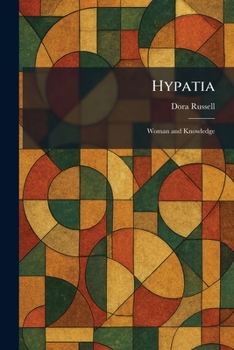
Hypatia: Woman and Knowledge

"Hypatia; Or, Woman and Knowledge" is a seminal feminist treatise that explores the intersection of intellectual liberty, education, and the social status of women. Written by the influential activist and thinker Dora Russell, this work serves as a passionate defense of women's right to knowledge and self-determination. Russell uses the historical figure of Hypatia, the ancient mathematician and philosopher, as a powerful symbol for the potential of the female mind and the historical challenges faced by women who seek intellectual fulfillment.
The text delves into complex themes of motherhood, marriage, and sexual ethics, advocating for a society that values women as independent thinkers rather than merely domestic figures. Russell argues that true societal progress depends on the liberation of women from traditional constraints, emphasizing that access to knowledge is the key to both individual autonomy and collective growth. This work remains a significant contribution to early 20th-century feminist discourse, offering a bold vision for gender equality and the importance of intellectual freedom for all. It provides a compelling look at the evolving arguments for social reform and the redefined role of women during a pivotal era in modern history.
This work has been selected by scholars as being culturally important, and is part of the knowledge base of civilization as we know it. This work was reproduced from the original artifact, and remains as true to the original work as possible. Therefore, you may see the original copyright references, library stamps (as most of these works have been housed in our most important libraries around the world), and other notations in the work.
This work is in the public domain in the United States of America, and possibly other nations. Within the United States, you may freely copy and distribute this work, as no entity (individual or corporate) has a copyright on the body of the work.
As a reproduction of a historical artifact, this work may contain missing or blurred pages, poor pictures, errant marks, etc. Scholars believe, and we concur, that this work is important enough to be preserved, reproduced, and made generally available to the public. We appreciate your support of the preservation process, and thank you for being an important part of keeping this knowledge alive and relevant.
Customer Reviews
ThriftBooks ® and the ThriftBooks ® logo are registered trademarks of Thrift Books Global, LLC
