


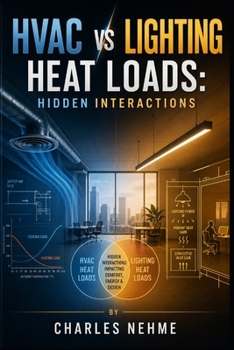
HVAC vs Lighting Heat Loads: Hidden Interactions

Lighting is often treated as an electrical design concern, while HVAC engineers focus on cooling and heating loads as if they were independent systems. In reality, lighting is one of the most underestimated contributors to internal heat gains in buildings, and its influence on HVAC performance is both direct and persistent.
For decades, building design has relied on simplified assumptions: watts in equals watts out, lighting loads are constant, and heat gain calculations are static. These assumptions worked reasonably well when incandescent and fluorescent lighting dominated. However, with the widespread adoption of LED technology, advanced lighting controls, daylight harvesting systems, and smart building automation, the relationship between lighting and HVAC has become far more dynamic-and far more complex.
This book explores the hidden interactions between HVAC systems and lighting heat loads. It challenges traditional design assumptions and highlights how lighting affects cooling demand, heating balance, air distribution, zoning behavior, and overall energy performance. More importantly, it exposes the gaps that often exist between design intent and real operational behavior in modern buildings.
The objective is not to complicate design, but to clarify it-by revealing the interdependence between two systems that are too often designed in isolation.
Customer Reviews
ThriftBooks ® and the ThriftBooks ® logo are registered trademarks of Thrift Books Global, LLC
