


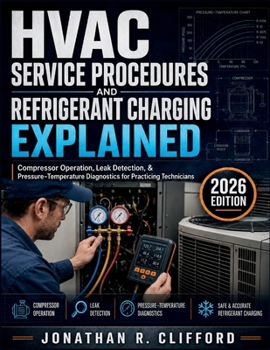
HVAC Service Procedures and Refrigerant Charging Explained: Compressor Operation, Leak Detection, & Pressure-Temperature Diagnostics for Practicing Te

The system that cooled fine last spring is low on charge again - and until you find the leak, fix it, pressure test it, and evacuate it correctly, everything else is just adding refrigerant to a problem.
Most callbacks happen because the diagnosis stopped at the gauges. High superheat gets refrigerant added. Low subcooling gets refrigerant added. A restricted filter-drier, a dirty condenser coil, and a failing compressor all get refrigerant added - until the compressor burns out and the customer stops calling you back for good.
This book builds the diagnostic foundation that stops that cycle: the refrigeration principles, the pressure-temperature logic, the charging methods, and the electrical troubleshooting skills that let you read a system correctly the first time and fix the actual problem.
Inside, you will find:
- The vapor compression cycle explained in field terms - not theory for theory's sake, but the pressure-temperature relationships you use every time you connect a manifold
- Four pressure relationship patterns that identify the fault category before you touch a single component
- The superheat and subcooling charging methods applied correctly - including why the metering device type determines which method you use and what happens when you use the wrong one
- EPA Section 608 recovery, evacuation, and documentation requirements explained with the field procedures that keep you compliant on every service call
- Leak detection using electronic, UV dye, and ultrasonic methods - combined with nitrogen pressure testing and micron gauge decay testing
- Heat pump reversing valve diagnosis, defrost system verification, and mode-specific charging in both cooling and heating operation
- Mini-split and VRF commissioning, factory charge correction, error code interpretation, and inverter compressor service
- Electrical troubleshooting using voltage drop testing, capacitor microfarad measurement, contactor diagnosis, and control board input-output signal verification
This book is written for HVAC apprentices, entry-level service technicians, EPA 608 candidates, NATE examination candidates, and field technicians building the diagnostic skills that separate them from parts changers.
GRAB YOUR COPY NOWRelated Subjects
Engineering Science Science & Math Science & Scientists Science & Technology TechnologyCustomer Reviews
ThriftBooks ® and the ThriftBooks ® logo are registered trademarks of Thrift Books Global, LLC
