


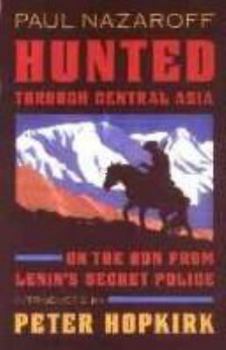
Hunted Through Central Asia


Select Format
Select Condition 
Book Overview
The story of Pavel Nazaroff reads more like something out of a spy thriller than one man's true story. Nazaroff, the ringleader of a plot to overthrow Bolshevik rule in Central Asia in 1918, was betrayed to the dreaded Cheka, or Bolshevik secret police, who quickly condemned him to death as "a known enemy of the proletariat." Just before his execution, however, a White Russian uprising stormed the prison in Tashkent where Nazaroff was held and in the confusion he escaped. And so began what he was later to describe as "a long and distant odyssey which would take me right across Central Asia, to the mysterious land of Tibet, and over the Himalayas to the plains of Hindustan."
On his journey we was aided by the Kirghiz and the Sarts, Moslem peoples who also detested the Bolsheviks. At one point, Nazaroff was walled up in a Sart's dwelling for his own protection, and for many months he lived "the life of a hunted animal." As the months passed, Nazaroff realized that his counter-revolutionary cause was a hopeless one, and that his only recourse was to flee across the world's tallest mountain range into China. The final stage of his adventure, in which he must evade both the pursuing Cheka and the Chinese border guards, will keep readers on the very edges of their seats.
Hunted Through Central Asia also offers a fascinating introduction to the life and times of Nazaroff by Peter Hopkirk, as well as an Epilogue in which Hopkirk includes details of the counter-revolutionary's life after his dramatic escape from the Cheka. Anyone who enjoys a good spy novel will be thrilled by this true story of espionage and international intrigue.
On his journey we was aided by the Kirghiz and the Sarts, Moslem peoples who also detested the Bolsheviks. At one point, Nazaroff was walled up in a Sart's dwelling for his own protection, and for many months he lived "the life of a hunted animal." As the months passed, Nazaroff realized that his counter-revolutionary cause was a hopeless one, and that his only recourse was to flee across the world's tallest mountain range into China. The final stage of his adventure, in which he must evade both the pursuing Cheka and the Chinese border guards, will keep readers on the very edges of their seats.
Hunted Through Central Asia also offers a fascinating introduction to the life and times of Nazaroff by Peter Hopkirk, as well as an Epilogue in which Hopkirk includes details of the counter-revolutionary's life after his dramatic escape from the Cheka. Anyone who enjoys a good spy novel will be thrilled by this true story of espionage and international intrigue.
Format:Paperback
Language:English
ISBN:0192852957
ISBN13:9780192852953
Release Date:December 1993
Publisher:Oxford University Press
Length:348 Pages
Weight:0.60 lbs.
Dimensions:7.8" x 0.9" x 5.1"
Related Subjects
Asia England Ethnic & National Europe History Irish Russia Science Science & Math Science & ScientistsCustomer Reviews
4 ratings
Eye-Witness to the Early Soviet Era
Published by Thriftbooks.com User , 17 years ago
This book is a combination travelogue and revolutionary thriller that, in important ways, is inadequate at both. The geopolitical terrain of Central Asia is very different from what Paul Nazaroff saw when he fled Lenin's secret police almost a hundred years ago. Even some of the geographical terrain is different -- he describes Pishpek as tiny and run-down; today it is Bishkek, the capital of modern Kygyzstan, with a population of 900,000. And the revolutionary thriller aspect of the book leaves out many of the details I would love to have seen. Nazaroff organized a major anti-Bolshevik uprising, but we don't know how or where or when: only that it failed, and forced the author to flee for his life. But take the book for what it is, and not what it isn't. We have a unique, eye-witness account of Soviet abuses in Central Asia after the turn of the century. We have a picture of lands that even today remain largely unknown. We have a proto-ethnography of interesting groups of people (chiefly the Sarts and the Kyrgyz) and the world in which they lived. And we have them through the eyes of a man who loved nature, freedom, and the excellence of the human spirit (whether Russian, Turkoman or otherwise), and who was not afraid to decry the abuses and failings of the communists.
Bolsheviks and Natural History in Central Asia
Published by Thriftbooks.com User , 21 years ago
Paul Nazaroff was a Russian geologist, naturalist and sportsman living in Tashkent at the time of the Bolshevik revolution. He was arrested, gaoled and interrogated by the Cheka on suspicion of being involved in the counter-revolutionary movement in Russian Turkestan. Naturally he denied being a participant, although enough hints appear in this autobiographical work (covering 1918 to 1920) to make it plain that he was a ringleader. Nazaroff managed to avoid the firing squad until Tashkent was liberated by the Whites. This liberation was short lived as the Soviet forces soon prevailed in a bloody counter-attack ending in mass executions. Nazaroff was forced into hiding amongst the native population - he spoke the local languages and had many contacts. The continuing search for him by the Bolsheviks forced him to move across Turkestan using forged papers and the aid of friends, all the time being in danger of being recognised. Nor did his troubles end upon crossing the Soviet border into China. His account not only covers his struggle to survive, but also highlights the destructive and bestial behaviour of the revolutionaries towards people and property, noting how the resources of this rich province were being squandered as uneducated brutes were placed in positions of authority with no check on their powers. But this is only part of the tale as the geology and natural history encountered en route are related in great detail, perhaps too much for some readers, while the lives of the native peoples, the Sarts and the Kirghiz, are illustrated by one of the few Europeans to have spent months living amongst them as an outsider in a family home. Little of political history will be found (other than an eyewitness account of the Bolsheviks in action and popular response) as the author was careful not to divulge confidences that even in 1932 had the potential to incite reprisals. What is presented is a panorama of a region that would remain closed to the outside world for seventy years as well as the courage and perseverance of the author. A brief epilogue by Peter Hopkirk details Nazaroff's later life.
On the run from the Soviets
Published by Thriftbooks.com User , 22 years ago
This book, first published seventy years ago, is a harrowing account of the author's escape from the Soviet Cheka shortly after the Russian Revolution. He was the leader of a group of rebels in Turkestan, and as such was a much sought after prize for the Bolsheviks, who wanted to eliminate him and all other opponents of their regime. The story is told in such a low-key way, however, that often it becomes a mere travelogue rather than a tale of action. For all of that, the underlying terror comes through, and the danger and hardship which the author faced appears very real to the reader. In addition to the main story, this book is also full of geography, geology, zoology, botany and history. The author was certainly a well-rounded individual, in addition to being very, very brave. We don't see many heroes such as this man in our times, and it's rewarding to read that such people were more than wiling to risk everything to combat tyranny.
An amazingly good read
Published by Thriftbooks.com User , 28 years ago
It is the story of a White Russian who was worked against the Bolshevik's during the Russian revolution. It provides chilling insight into the reign of terror but also fascinating information on life in Central Asia during the 1920's. Highly recommended
Copyright © 2025 Thriftbooks.com
Terms of Use | Privacy Policy | Do Not Sell/Share My Personal Information | Cookie Policy | Cookie Preferences | Accessibility Statement
ThriftBooks ® and the ThriftBooks ® logo are registered trademarks of Thrift Books Global, LLC
ThriftBooks ® and the ThriftBooks ® logo are registered trademarks of Thrift Books Global, LLC
