


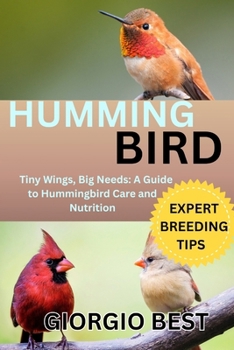
Hummingbird: Tiny Wings, Big needs - A Guide to Hummingbird Care and Nutrition
No Customer Reviews

Throughout human history, hummingbirds have occupied a unique place in the spiritual, cultural, and mythological consciousness of civilizations across the Americas. Their diminutive size, brilliant plumage, and astonishing aerial capabilities have inspired reverence, storytelling, and symbolic interpretation across diverse societies-particularly among Indigenous peoples of Mesoamerica, South America, and the Caribbean.
In Aztec mythology, the hummingbird was deeply associated with Huitzilopochtli, the god of the sun, war, and human sacrifice. His name translates to "Hummingbird of the South," and he was often depicted as a warrior adorned in hummingbird feathers. Huitzilopochtli symbolized power, divine guidance, and resurrection. Aztec warriors who perished in battle were believed to be reincarnated as hummingbirds, destined to drink the nectar of flowers in eternal bliss. This linkage elevated the bird as a sacred embodiment of courage and spiritual vitality.
Among the Inca civilization, hummingbirds were considered messengers between the living and the spirit world. Their presence was interpreted as a divine sign-often associated with rebirth or transformation. In some Andean traditions, they are seen as beings capable of traversing both the physical and metaphysical realms, bridging earthly experience with the spiritual plane.
The Taino people of the Caribbean believed the hummingbird was born from the ashes of war. According to legend, a beautiful maiden transformed into a hummingbird after her warrior lover died in battle. For the Taino, the bird came to symbolize peace, renewal, and the endurance of love beyond death.
Modern Indigenous communities in the Amazon, such as the Kayapo and Yanomami, view the hummingbird as a harbinger of rain, fertility, and seasonal cycles. Because of their connection to flowering plants and natural rhythms, hummingbirds often represent environmental equilibrium and the continuity of life.
In contemporary culture, the hummingbird's image has transcended folklore to become a universal symbol of joy, resilience, and adaptability. Its constant motion and ability to hover in place evoke metaphors of mindfulness, while its capacity for long-distance migration has become emblematic of endurance and tenacity. In literature and art, the hummingbird is frequently portrayed as a representation of fleeting beauty, emotional delicacy, or the pursuit of the impossible.
Across North and South America, hummingbird feathers have been used in ceremonial attire, regalia, and rituals-though such practices are now discouraged or prohibited due to conservation concerns. Nevertheless, the symbolic richness of the hummingbird continues to inform spiritual practices, visual arts, jewelry, tattoos, and storytelling, reinforcing its enduring significance in human cultural heritage.
In Aztec mythology, the hummingbird was deeply associated with Huitzilopochtli, the god of the sun, war, and human sacrifice. His name translates to "Hummingbird of the South," and he was often depicted as a warrior adorned in hummingbird feathers. Huitzilopochtli symbolized power, divine guidance, and resurrection. Aztec warriors who perished in battle were believed to be reincarnated as hummingbirds, destined to drink the nectar of flowers in eternal bliss. This linkage elevated the bird as a sacred embodiment of courage and spiritual vitality.
Among the Inca civilization, hummingbirds were considered messengers between the living and the spirit world. Their presence was interpreted as a divine sign-often associated with rebirth or transformation. In some Andean traditions, they are seen as beings capable of traversing both the physical and metaphysical realms, bridging earthly experience with the spiritual plane.
The Taino people of the Caribbean believed the hummingbird was born from the ashes of war. According to legend, a beautiful maiden transformed into a hummingbird after her warrior lover died in battle. For the Taino, the bird came to symbolize peace, renewal, and the endurance of love beyond death.
Modern Indigenous communities in the Amazon, such as the Kayapo and Yanomami, view the hummingbird as a harbinger of rain, fertility, and seasonal cycles. Because of their connection to flowering plants and natural rhythms, hummingbirds often represent environmental equilibrium and the continuity of life.
In contemporary culture, the hummingbird's image has transcended folklore to become a universal symbol of joy, resilience, and adaptability. Its constant motion and ability to hover in place evoke metaphors of mindfulness, while its capacity for long-distance migration has become emblematic of endurance and tenacity. In literature and art, the hummingbird is frequently portrayed as a representation of fleeting beauty, emotional delicacy, or the pursuit of the impossible.
Across North and South America, hummingbird feathers have been used in ceremonial attire, regalia, and rituals-though such practices are now discouraged or prohibited due to conservation concerns. Nevertheless, the symbolic richness of the hummingbird continues to inform spiritual practices, visual arts, jewelry, tattoos, and storytelling, reinforcing its enduring significance in human cultural heritage.
Format:Paperback
Language:English
ISBN:B0FNYTTZHY
ISBN13:9798298928083
Release Date:August 2025
Publisher:Independently Published
Length:168 Pages
Weight:0.51 lbs.
Dimensions:0.4" x 6.0" x 9.0"
Customer Reviews
0 rating
Copyright © 2026 Thriftbooks.com
Terms of Use | Privacy Policy | Do Not Sell/Share My Personal Information | Cookie Policy | Cookie Preferences | Accessibility Statement
ThriftBooks ® and the ThriftBooks ® logo are registered trademarks of Thrift Books Global, LLC
ThriftBooks ® and the ThriftBooks ® logo are registered trademarks of Thrift Books Global, LLC
