


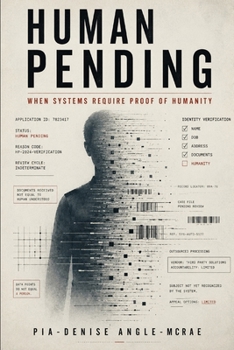
Human...Pending: When Systems Require Proof of Humanity

Human Pending examines what happens when modern systems become better at processing people than understanding them.
In a world increasingly governed by identity verification, automation, outsourced vendors, algorithmic screening, and rigid compliance rules, human beings are often reduced to cases, claimants, users, applicants, risks, or unresolved records. Systems created to provide security and efficiency can quietly become barriers when they lose the ability to recognize disaster, instability, poverty, broken technology, lost documents, or human complexity.
This book explores the growing gap between procedural compliance and human reality. From employment and housing to healthcare, public benefits, digital identity, and customer support, Human Pending investigates how people can become trapped in systems that acknowledge their paperwork more easily than their humanity.
Written as accessible institutional analysis, this book is not anti-technology or anti-security. Instead, it asks a deeper question:
What kind of society are we building when recognition depends on successful verificati
on?
Clear, unsettling, and timely, Human Pending is for readers interested in leadership, ethics, technology, bureaucracy, public policy, organizational behavior, and the human cost of systems that cannot adapt.
Customer Reviews
ThriftBooks ® and the ThriftBooks ® logo are registered trademarks of Thrift Books Global, LLC
