


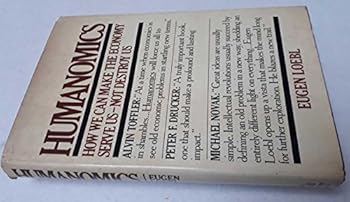
Humanomics: How we can make the economy serve us--not destroy us


No Synopsis Available.
Format:Hardcover
Language:English
ISBN:0394499441
ISBN13:9780394499444
Release Date:January 1976
Publisher:Random House
Length:164 Pages
Weight:0.75 lbs.
Customer Reviews
1 rating
putting human thinking back at center of economic activity
Published by Thriftbooks.com User , 18 years ago
"Humanomics" is a 21-year-old book, but much of its message appears relevant today. The problem it poses is that economics has lost its moral mission by its continued "aping" of physics, especially Newtonian determinism. The aping perpetuates fallacies, and the book proposes five ways to make the "economy serve us - not destroy us". These include rethinking our world, dropping fallacies, reconsidering two revolutions, establishing an effective macro-organ and its policy tools, and promoting economic democracy. Key among the fallacies is the "resource allocation" fallacy, which forms the basis of the definition of economics. Other fallacies pertain to economic laws, including concepts like the market, demand and supply, and a "truism" of diminishing marginal returns. Regarding the latter, the book states that "the real reasons for diminishing returns are errors in the realm of thinking, judgment, and expectations" (p. 72). The author claims that the fallacies market, demand and supply, and diminishing marginal returns ignore that an economy is an integrated system whose life depends on human thinking. Human thinking is a dynamic process so that "in any developed economy, there is not even a tendency toward equilibrium. Disequilibrium is the normal state, equilibrium is the anomaly" (p. 76). Recurrent instability of prices and employment suggests rampant disequilibria. Thus, conventional economics is misdirected in its attempts to build "sophisticated theories and simpler measures"; humanomics is correct in focusing on "simpler theories, and sophisticated measures" (p.77). Part 3 of the book is on two economic revolutions: the planned revolution emanating in the Soviet economic model, and the Keynesian revolution. The Soviet model failed because macro-organs and micro-organs of advanced economies are different, and plans, no matter how logical do not work. For example, the interest of the planner is to have everyone employed. Full employment without changing production targets results in "disproportions" The Keynesian revolution sought to develop a general theory of employment in which equilibrium is a partial (special) case. The author claims that both revolutions were not real revolutions because the Soviet model makes "... man, instead of a beneficiary, an object of planning; instead of controlling the economy, he is being controlled." (p. 91). The Keynesian model does a good job in addressing unemployment, but is not dramatically different from classical economics. Both models fail to acknowledge that an economy is an integrated system driven by human thinking. Mature economies are not "self-recuperative". The fourth section of the book discusses how to establish a macro-organ and select its policy tools (money supply), oust the consumer unfriendly taxation system ("the orientation of the economy toward the interests of the consumer"), and stabilize the purchasing power of money. Present day central banks continue to deal with these issue
Copyright © 2026 Thriftbooks.com Terms of Use
| Privacy Policy | Do Not
Sell/Share My Personal Information | Cookie Policy | Cookie Preferences | Accessibility Statement
ThriftBooks® and the ThriftBooks® logo are registered trademarks of Thrift Books Global, LLC
ThriftBooks® and the ThriftBooks® logo are registered trademarks of Thrift Books Global, LLC
