


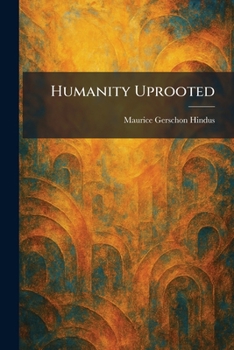
Humanity Uprooted

"Humanity Uprooted" is a compelling firsthand examination of the profound social and cultural transformations sweeping across the Soviet Union in the decade following the Bolshevik Revolution. Maurice Hindus provides an insightful and empathetic account of how the revolutionary tide fundamentally altered the lives of millions, from the peasantry and the proletariat to the intelligentsia and the youth. The work explores the radical shifts in traditional institutions, including religion, family life, property, and morality, as the new Soviet state sought to forge a novel human consciousness and a different social order.
Through vivid reportage and sociological observation, Hindus captures the raw energy, the suffering, and the ideological fervor of a nation in the throes of unprecedented change. This book remains a significant historical document for understanding the early Soviet experiment and its impact on the collective psyche of the Russian people. It offers a detailed portrait of a society in transition, making it essential reading for those interested in the history of communism, social upheaval, and the human dimensions of political revolution.
This work has been selected by scholars as being culturally important, and is part of the knowledge base of civilization as we know it. This work was reproduced from the original artifact, and remains as true to the original work as possible. Therefore, you may see the original copyright references, library stamps (as most of these works have been housed in our most important libraries around the world), and other notations in the work.
This work is in the public domain in the United States of America, and possibly other nations. Within the United States, you may freely copy and distribute this work, as no entity (individual or corporate) has a copyright on the body of the work.
As a reproduction of a historical artifact, this work may contain missing or blurred pages, poor pictures, errant marks, etc. Scholars believe, and we concur, that this work is important enough to be preserved, reproduced, and made generally available to the public. We appreciate your support of the preservation process, and thank you for being an important part of keeping this knowledge alive and relevant.
Customer Reviews
ThriftBooks ® and the ThriftBooks ® logo are registered trademarks of Thrift Books Global, LLC
