


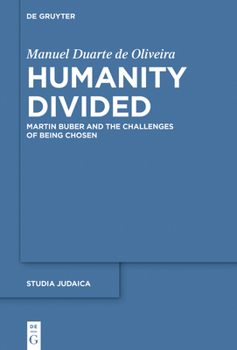
Humanity Divided
No Customer Reviews

With exacting scholarship and fecund analysis, Manuel Oliveira probes through the lens of Martin Buber (1878-1965) the theological and political ambiguities of Israel's divine election. These ambiguities became especially pronounced with the emergence of Zionism. Wary, indeed, alarmed by the tendency of some of his fellow Zionists to conflate divine chosenness with nationalism, Buber sought to secure the theological significance of election by both steering Zionism from hypertrophic nationalism and by a sustained program to revalorize what he called alternately "Hebrew Humanism." As Oliveira demonstrates, Buber viewed the idea of election teleologically, espousing a universal mission of Israel, which effectively calls upon Zionism to align its political and cultural project to universal objectives. Thus, in addressing a Zionist congress, he rhetorically asked, "What then is this spirit of Israel of which you are speaking? It is the spirit of fulfillment. Fulfillment of what? Fulfillment of the simple truth that man has been created for a purpose (...) Our purpose is the upbuilding of peace (...) And that is its spirit, the spirit of Israel (...) the people of Israel was charged to lead the way to righteousness and justice."
Format:Hardcover
Language:English
ISBN:3110740745
ISBN13:9783110740745
Release Date:September 2021
Publisher:de Gruyter GmbH, Walter
Length:584 Pages
Weight:2.14 lbs.
Dimensions:1.4" x 6.1" x 9.1"
Grade Range:Postsecondary
Customer Reviews
0 rating
Copyright © 2026 Thriftbooks.com Terms of Use
| Privacy Policy | Do Not
Sell/Share My Personal Information | Cookie Policy | Cookie Preferences | Accessibility Statement
ThriftBooks® and the ThriftBooks® logo are registered trademarks of Thrift Books Global, LLC
ThriftBooks® and the ThriftBooks® logo are registered trademarks of Thrift Books Global, LLC
