


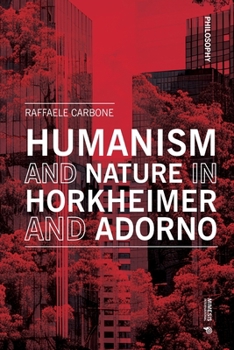
Humanism and Nature in Horkheimer and Adorno
No Customer Reviews

In the early Frankfurt School, especially in Horkheimer and Adorno, we find a critical attitude towards the traditional concepts of "humanism" and "nature". Frankfurt thinkers tackle these concepts of Western philosophy but with the aim of showing their internal limits and their dialectical connections. Indeed, they also consider the possibility of resemantising these concepts in the light of the specific needs of critical theory. On the basis of this approach, this book shows that Horkheimer and Adorno's critical reflection on the destructive and self-destructive relation of human beings to nature goes back to 1930, decades before the environmental movement emerged in the 1960s. On various occasions, and together in "Dialectic of Enlightenment", they explain how the character of the relationship between humans and nature has been one of domination. By highlighting the ambiguous outcome of Enlightenment, which has proven to be a double-edged sword (emancipation/barbarism), in particular when reason reduces itself to its instrumental dimension, they try to reinscribe human activities within broader natural parameters, without neglecting the fact that nature and history, environment and social domains are always inextricably intertwined.
Format:Paperback
Language:English
ISBN:8869775550
ISBN13:9788869775550
Release Date:July 2026
Publisher:Mimesis
Length:234 Pages
Weight:0.59 lbs.
Dimensions:0.5" x 5.5" x 8.3"
Customer Reviews
0 rating
Copyright © 2026 Thriftbooks.com
Terms of Use | Privacy Policy | Do Not Sell/Share My Personal Information | Cookie Policy | Cookie Preferences | Accessibility Statement
ThriftBooks ® and the ThriftBooks ® logo are registered trademarks of Thrift Books Global, LLC
ThriftBooks ® and the ThriftBooks ® logo are registered trademarks of Thrift Books Global, LLC
