


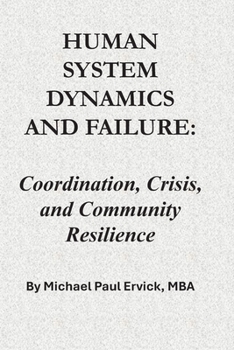
Human System Dynamics and Failure: Coordination, Crisis, and Community Resilience
No Customer Reviews

Human System Dynamics and Failure: Coordination, Crisis, and Community Resilience by Michael Paul Ervick is a systems-level examination of how human coordination behaves under pressure, particularly during crisis, disruption, and institutional strain.
At its core, the book argues that crises do not primarily destroy capability - they disrupt coordination. Formal systems built for stability begin to lose alignment as information fragments, trust weakens, time compresses, and conditions evolve faster than centralized structures can respond. Yet even as formal coordination degrades, people continue to adapt, connect, decide, and act. Coordination does not disappear; it relocates to the human level.
The book explores this transition in detail, tracing how systems designed around hierarchy, procedure, and predictability struggle under real-world conditions where ambiguity, simultaneity, and uncertainty dominate. Plans assume stable conditions. Crisis removes them.
From this foundation, the work develops a broader theory of human system dynamics through several interconnected themes: the collapse of centralized awareness under time compression, the fragmentation of information and trust, the rise of informal networks, the emergence of tactical adhocracy, and the formation of "nexus points" where information, decision-making, and action converge in real time.Rather than treating crisis as a failure of individual effort, the book frames systemic failure as the persistence of organizational models that no longer align with reality. Systems fail not because people stop working, but because coordination breaks across the system as a whole.
A central insight throughout the manuscript is that human relationships become the true infrastructure of resilience when formal structures weaken. Under stress, coordination increasingly depends on: trust, direct communication, local decision-making, shared purpose, and adaptive networks built through human connection.The book also introduces the concept of tactical adhocracy - decentralized, relationship-driven coordination that emerges organically during crises. These adaptive networks move information, resources, and decisions faster than rigid bureaucratic systems can under compressed time conditions.
Importantly, the work does not romanticize disorder or reject structure. Instead, it argues that resilience emerges through the integration of stable systems with adaptive human networks. Structure provides continuity; adhocracy provides flexibility. Sustainable coordination requires both.
As the book progresses, it expands beyond operational disaster response into broader societal dynamics, examining how economic systems, social trust, information ecosystems, cultural narratives, and political legitimacy interact under sustained stress. Failures propagate across systems, reinforcing fragmentation unless adaptive coordination can emerge quickly enough to restore flow and alignment.
Ultimately, the book presents a theory of resilience grounded not in institutional perfection, but in human adaptability. Even after systemic collapse, people continue to connect, organize, and rebuild through local networks, shared understanding, and emergent coordination. Recovery, the book argues, is not restoration of the old system - it is the emergence of new patterns better aligned with reality.
The work sits at the intersection of: systems theory, disaster response, organizational behavior, network dynamics, community resilience, and adaptive leadership.It is especially relevant for emergency management professionals, humanitarian organizations, volunteer networks, policymakers, community leaders, and anyone seeking to understand how human systems behave when formal structures come under extreme pressure.
At its core, the book argues that crises do not primarily destroy capability - they disrupt coordination. Formal systems built for stability begin to lose alignment as information fragments, trust weakens, time compresses, and conditions evolve faster than centralized structures can respond. Yet even as formal coordination degrades, people continue to adapt, connect, decide, and act. Coordination does not disappear; it relocates to the human level.
The book explores this transition in detail, tracing how systems designed around hierarchy, procedure, and predictability struggle under real-world conditions where ambiguity, simultaneity, and uncertainty dominate. Plans assume stable conditions. Crisis removes them.
From this foundation, the work develops a broader theory of human system dynamics through several interconnected themes: the collapse of centralized awareness under time compression, the fragmentation of information and trust, the rise of informal networks, the emergence of tactical adhocracy, and the formation of "nexus points" where information, decision-making, and action converge in real time.Rather than treating crisis as a failure of individual effort, the book frames systemic failure as the persistence of organizational models that no longer align with reality. Systems fail not because people stop working, but because coordination breaks across the system as a whole.
A central insight throughout the manuscript is that human relationships become the true infrastructure of resilience when formal structures weaken. Under stress, coordination increasingly depends on: trust, direct communication, local decision-making, shared purpose, and adaptive networks built through human connection.The book also introduces the concept of tactical adhocracy - decentralized, relationship-driven coordination that emerges organically during crises. These adaptive networks move information, resources, and decisions faster than rigid bureaucratic systems can under compressed time conditions.
Importantly, the work does not romanticize disorder or reject structure. Instead, it argues that resilience emerges through the integration of stable systems with adaptive human networks. Structure provides continuity; adhocracy provides flexibility. Sustainable coordination requires both.
As the book progresses, it expands beyond operational disaster response into broader societal dynamics, examining how economic systems, social trust, information ecosystems, cultural narratives, and political legitimacy interact under sustained stress. Failures propagate across systems, reinforcing fragmentation unless adaptive coordination can emerge quickly enough to restore flow and alignment.
Ultimately, the book presents a theory of resilience grounded not in institutional perfection, but in human adaptability. Even after systemic collapse, people continue to connect, organize, and rebuild through local networks, shared understanding, and emergent coordination. Recovery, the book argues, is not restoration of the old system - it is the emergence of new patterns better aligned with reality.
The work sits at the intersection of: systems theory, disaster response, organizational behavior, network dynamics, community resilience, and adaptive leadership.It is especially relevant for emergency management professionals, humanitarian organizations, volunteer networks, policymakers, community leaders, and anyone seeking to understand how human systems behave when formal structures come under extreme pressure.
Format:Paperback
Language:English
ISBN:B0H5RG55KH
ISBN13:9798197219916
Release Date:June 2026
Publisher:Independently Published
Length:164 Pages
Weight:0.45 lbs.
Dimensions:0.4" x 6.0" x 9.0"
Customer Reviews
0 rating
Copyright © 2026 Thriftbooks.com
Terms of Use | Privacy Policy | Do Not Sell/Share My Personal Information | Cookie Policy | Cookie Preferences | Accessibility Statement
ThriftBooks ® and the ThriftBooks ® logo are registered trademarks of Thrift Books Global, LLC
ThriftBooks ® and the ThriftBooks ® logo are registered trademarks of Thrift Books Global, LLC
