


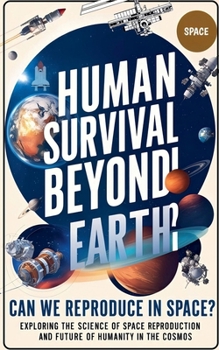
Human Survival Beyond Earth: Can We Reproduce in Space?

Human Survival Beyond Earth: Can We Reproduce in Space? explores one of the most exciting and critical questions facing humanity as we look toward the stars: can we reproduce in space? As the dream of establishing human colonies on other planets becomes more tangible, understanding how to sustain life-including reproducing-beyond Earth is essential for the long-term survival of our species.
In this book, the author delves into the science of space reproduction, examining how microgravity, radiation, and other challenges of space travel could impact human fertility and pregnancy. Through detailed explanations and insights from groundbreaking experiments, including the study of mice sperm in space, the book investigates the biological challenges that must be overcome to make reproduction in space a reality.
From the basics of human reproduction on Earth to the innovative technologies being developed to address space's unique challenges, this book provides a comprehensive overview of the obstacles and potential solutions. Topics such as radiation shielding, artificial gravity, cryopreservation, genetic engineering, and artificial reproductive technologies are explored, offering a hopeful vision of how science might enable humanity to thrive on distant worlds.
The book also touches on the ethical, social, and cultural implications of reproducing in space, discussing the moral dilemmas and cultural shifts that will arise as humanity begins to extend its reach into the cosmos. Ultimately, Human Survival Beyond Earth presents a bold vision of humanity's future, where successful reproduction in space could ensure our survival across multiple planets, turning the dream of interplanetary civilization into a reality.
This thought-provoking exploration is for anyone interested in the future of space exploration, human biology, and the possibilities of life beyond Earth.
Customer Reviews
ThriftBooks® and the ThriftBooks® logo are registered trademarks of Thrift Books Global, LLC
