


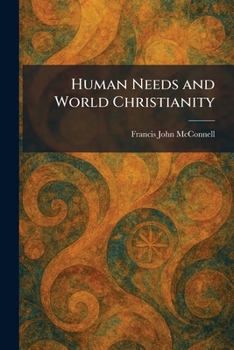
Human Needs and World Christianity

"Human Needs and World Christianity" is a compelling examination of the social responsibilities of the global Christian movement. Written by Francis John McConnell, a prominent leader in the social gospel movement, this work explores the fundamental connection between religious faith and the fulfillment of basic human needs. McConnell argues that the relevance of Christianity in a modernizing world depends on its ability to address tangible issues such as poverty, disease, and social injustice.
The book provides a thoughtful analysis of how missions and ecclesiastical institutions must evolve to serve humanity more effectively. It emphasizes a vision of world Christianity that transcends mere dogma, focusing instead on the practical application of Christian ethics to improve living conditions across the globe. Through chapters dedicated to health, education, and economic stability, the author presents a persuasive case for a faith-driven commitment to universal human welfare. This work remains a significant historical document for readers interested in the development of 20th-century religious thought, the history of missions, and the ethical foundations of social reform.
This work has been selected by scholars as being culturally important, and is part of the knowledge base of civilization as we know it. This work was reproduced from the original artifact, and remains as true to the original work as possible. Therefore, you may see the original copyright references, library stamps (as most of these works have been housed in our most important libraries around the world), and other notations in the work.
This work is in the public domain in the United States of America, and possibly other nations. Within the United States, you may freely copy and distribute this work, as no entity (individual or corporate) has a copyright on the body of the work.
As a reproduction of a historical artifact, this work may contain missing or blurred pages, poor pictures, errant marks, etc. Scholars believe, and we concur, that this work is important enough to be preserved, reproduced, and made generally available to the public. We appreciate your support of the preservation process, and thank you for being an important part of keeping this knowledge alive and relevant.
Customer Reviews
ThriftBooks ® and the ThriftBooks ® logo are registered trademarks of Thrift Books Global, LLC
