


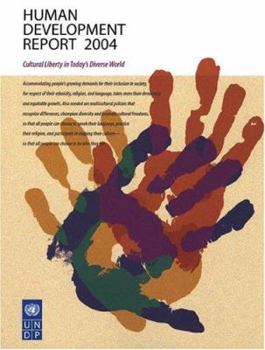
Human Development Report 2004: Cultural Liberty in Today's Diverse World

The Human Development Report 2004 debunks myths that regard diversity as a threat to nations and states, the source of inevitable clashes, and an obstacle to development. It asserts that struggles over economic resources and political power, not diversity, are most often at the root of conflict. The Report opens with an analysis of the vital links between human development and cultural liberty by Nobel Laureate Amartya Sen. It goes on to examine issues that the dynamics of globalization have brought to the forefront of policy agendas in rich and poor countries alike: migration, predatory extremism, and the expansion of cultural diversity. Drawing on data from national and local governments around the world, it proposes evidence-based constitutional, juridical, and socioeconomic policy options to promote cultural liberty and multicultural democracy in the context of universally accepted human rights.
Format:Paperback
Language:English
ISBN:019522146X
ISBN13:9780195221466
Release Date:July 2004
Publisher:Oxford University Press
Length:184 Pages
Weight:1.86 lbs.
Dimensions:8.4" x 0.6" x 10.9"
Related Subjects
Business Business & Finance Business & Investing Business Development Development & Growth Diplomacy Economic Conditions Economic Policy Economic Policy & Development Economics Education & Reference Engineering International Relations Philosophy Political Economy Political Science Politics & Government Politics & Social Sciences Popular Economics Public Affairs & Policy Public Policy Social Services & Welfare TechnologyCustomer Reviews
1 rating
Forecasting future from a new perspective
Published by Thriftbooks.com User , 20 years ago
When Egypt's president revealed a drive for improving democracy a year ago, the deputy head of the country's top appeals court felt hope, but today, are Egypt's democratic reforms complete? Recently Pakistan has banned anti-cartoon rallies in Lahore after several demonstrations turned deadly, but can the same protests be totally controlled in other parts of the Islamic world? When thousands of demonstrators marched through Paris to protest racism after the killing of a Paris Jew, do you really think it just an incident? These are just some headlines from today's AP news. Coping with cultural diversity is one of the central challenges of the 21st century. Nowadays, while most people are concerned about the future of technological new frontiers such as artificial intelligence, nanotechnology and gene technology, I am more curious about the status quo of our human societies, cultures and its implications for forecasting the future. This can be best explained why I chose to read the book, Human Development Report 2004. This book is about discussing human development from a global perspective. As this book alerts us, "a global clash of cultures" is now happening. Like all UNDP's Human Development Reports, this book is actually an independent study intended to encourage discussion about human rights, cultural diversity, globalization, cultural liberty, etc. From my point of view, those are basic issues and at least continue to be "hot" and even getting hotter in the rest of this century. In other words, when people forecast new trends and changes of technologies, it is unfair to assume that the human society will simultaneously develop as technologies do. The fact is just the opposite: people always overlook or neglect those issues when they are preoccupied by fascinating technologies. In addition, technologies degenerate human development by making masses of people lazy and indulging people with convenience and effortless lives. One of the book's strengths is that it takes you through cultural issues around the world by which the authors make a case for respecting diversity and building more inclusive societies by adopting policies that explicitly recognize cultural differences-multicultural policies. Another powerful section was on building of multicultural democracies. Among many issues mentioned in this book, cultural liberty is the one that fascinated me. According to the authors, cultural liberty is a vital part of human development because being able to choose one's identity-who one is-without losing the respect of others or being excluded from other choices is important in leading a full life. Because minority identity was my former research area eight years ago when I pursued my first MA in cultural anthropology, I can well understand today's conflicts from a perspective of cultural identity. In the future, war will involved more identity disputes, especially when you realize that most countries of our world share the same cultural diversity.
Copyright © 2026 Thriftbooks.com
Terms of Use | Privacy Policy | Do Not Sell/Share My Personal Information | Cookie Policy | Cookie Preferences | Accessibility Statement
ThriftBooks ® and the ThriftBooks ® logo are registered trademarks of Thrift Books Global, LLC
ThriftBooks ® and the ThriftBooks ® logo are registered trademarks of Thrift Books Global, LLC
