


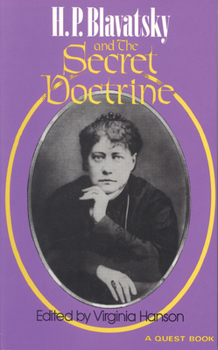
H. P. Blavatsky and the Secret Doctrine


An anthology of Blavatasky's contributions to world thought.
Format:Paperback
Language:English
ISBN:0835606309
ISBN13:9780835606301
Release Date:May 1988
Publisher:Quest Books (IL)
Length:263 Pages
Weight:0.79 lbs.
Dimensions:0.7" x 5.3" x 8.3"
Customer Reviews
1 rating
Evolution and Involution: A Possible Convergence
Published by Thriftbooks.com User , 24 years ago
In this anthology of twenty-one essays, published as a companion volume to "An Abridgement of The Secret Doctine," editor Virginia Hanson brings together friendly perspectives on the still evolving significance of Blavatsky's monumental work of 1888. While the essays vary in quality and argumentative power, in consort they generate the sense that "The Secret Doctrine," when prunned of some of its outdated science, or even pseudo-science, still expresses an important and viable world-view that should be wrestled with by anyone interested in cosmology and human genesis. I have no doubts that H.P.B (as she is referred to in esoteric circles) was a genius of high order, although she many have had some borderline features that made her especially open to vibrations and forces that are otherwise outside of normal forms of awareness. Her culminating work was written under the impress of two Adepts who dictated passages to her or who showed her screen images of material they wanted transcribed. Were the Adepts (Koot Hoomi and Morya) actual living beings of supranatural wisdom (as she claimed),were they mental delusions (as many claim), or were they viable projections of her Self Archetype? I would argue that the last claim is certainly true, while the first might be true. The second claim seems to be without warrant, given the high calaber of the writing itself. One mark of the presence of the Self Archetype in a creative product is the unusually strong conjunction of coherence and power. This conjunction is well evident in "The Secret Doctrine." The essays in this book transform the basic categories of H.P.B. so that they can show their continuing relevance for science, the history of the visual arts, and theories of consciousness. Perhaps most difficult is the problem of reconciling the reigning neoDarwinian synthesis in biology, with its focus on random variation, natural selection, adaptability, and self-organization (for some theoriests) with H.P.B.'s thesis that all biological evolution is actually the result of a prior involution in which spiritual beings gradually become more and more encased in material shells. It is false to say that she simply rejected Darwin, as her views on his work are actually quite complex. But she felt that his conceptions had limited scope. Cosmic involution (the descent of spirit into matter) is temporally and ontologically prior to the more obvious mechanisms of biological evolution. Can these alternative views be joined together? Thinkers as diverse as Sri Aurobindo, the physicist Hugh Murdoch (in the anthology), and the physicist Amit Goswami, have argued that they can. The latter two thinkers use quantum theory in novel ways to show just how spirit can enter into certain moments of evolutionary openness to bring about the rare, but central, conjunction of involution (spirit) and evolution (matter). There are also some hints that H.P.B.'s cosmology might be friendly to quantum theory (especially q
Copyright © 2026 Thriftbooks.com Terms of Use
| Privacy Policy | Do Not
Sell/Share My Personal Information | Cookie Policy | Cookie Preferences | Accessibility Statement
ThriftBooks® and the ThriftBooks® logo are registered trademarks of Thrift Books Global, LLC
ThriftBooks® and the ThriftBooks® logo are registered trademarks of Thrift Books Global, LLC
