


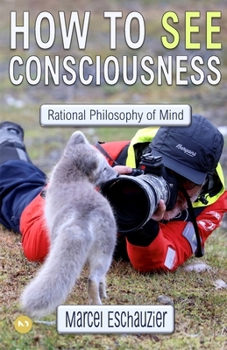
How to See Consciousness: Rational Philosophy of Mind

What if the hard problem of consciousness disappears when you look at it the right way?
How to See Consciousness takes you beneath the usual debate about mind and matter to the assumption that drives it: that the knower and the known begin apart, and that consciousness must somehow be found inside a world already complete without it.
This is not a casual read. It uses the language of contemporary philosophy and asks for close attention. The reward is a new way to judge every theory of consciousness-and to question the split your own thinking may take for granted. Hume, Kant, the hard problem, causation, neuroscience, physicalism, and panpsychism converge on one question:
When does a difference in experience justify a division in reality?
The answer developed here is rational nondualism: a philosophy that keeps the force of reason and science while challenging the separation they are often made to assume. For readers trained in philosophy or consciousness studies, it offers an original argument worth testing, opposing, and carrying further.
For readers drawn to nonduality, it offers something rarer: non-separation without mysticism, borrowed authority, or vague spiritual language. You are not asked to deny the world, dismiss difference, or retreat from reason. Memory, embodiment, causation, other minds, and science remain fully in view. What falls under scrutiny is the leap from distinction to independent existence.The Simply Nondual Collection explores the same recognition through story, dialogue, existential reflection, and philosophical adventure. Here it appears in its most rigorous form, tested against contemporary philosophy of mind and consciousness science.
You may begin by asking how consciousness fits into reality.You may finish by questioning the division that made the problem seem real.Customer Reviews
ThriftBooks ® and the ThriftBooks ® logo are registered trademarks of Thrift Books Global, LLC
