


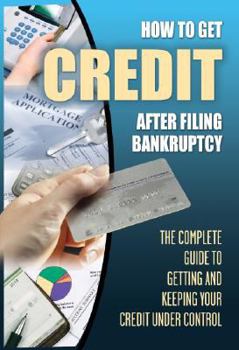
How to Get Credit after Filing Bankruptcy The Complete Guide to Getting and Keeping Your Credit Under Control


According to the United States Bankruptcy Courts, the number of bankruptcies filed each year is on the rise. People file bankruptcy for a variety of reasons, such as preventing foreclosure on their... This description may be from another edition of this product.
Format:Paperback
Language:English
ISBN:1601381379
ISBN13:9781601381378
Release Date:April 2008
Publisher:Atlantic Publishing Company
Length:288 Pages
Weight:0.80 lbs.
Dimensions:8.8" x 0.7" x 6.0"
Customer Reviews
4 ratings
Good read
Published by Thriftbooks.com User , 16 years ago
In this book, Wakem explains in-depth about the different bankruptcy options available to individuals and its repercussions. The author starts with the definition of bankruptcy and goes on to describe the several options like Chapter 7, Chapter 11, Chapter 12 and Chapter 13. There is more emphasis on Chapter 7 and 13 when compared to the other two chapters because of its relevance to individuals struggling to get out of their credit problems. Many myths surrounding bankruptcy are quashed by the author by using relevant legislation. The author also suggests ways and means to bring finances under one's control. A clear and concise plan to recover from bankruptcy and to take charge of life is well-elucidated by the author. She also delves into credit cards, loans and mortgage payments and the areas where an individual should watch out to avoid paying huge rates of interest after bankruptcy. Overall, it is well-written book that can be a perfect guide for people coping with credit problems. This subject assumes a lot of importance in the current economic downturn because more and more people are looking for ways out of their problems. Though some information like the procedure and exemptions under Chapter 7 are repeated over and over again, it is still a handy book for today's environment. In short, this is a practical hand book for anyone considering bankruptcy because it gives a clear idea of the process as well as life after filing bankruptcy.
Very helpful
Published by Thriftbooks.com User , 16 years ago
How to Get Credit After Filing for Bankruptcy: The Complete Guide to and Keeping Your Credit Under Control by Mitchell Wakem provides information useful for anyone going through financial troubles. Wakem guides the reader through the process of filing for bankruptcy, explains its positives and negatives, and then provides various ways to rebuild credit afterwards. He deflates certain myths about bankruptcy and points out many of the dangers that take advantage of the unwary. Wakem provides clear, concise, and easily understood explanations for concepts that are often confusing the grasp. One part of the book that I found particularly interesting is Chapter 3, where Wakem delves into bankruptcy's effect on family and personal life. Since this is a topic not often covered in financial self-help books, I found its inclusion completed the book as a whole. Wakem warns the reader of the pitfalls set before them, but also reassures them that there is indeed a future after bankruptcy. In these troubling times, How to Get Credit After Filing for Bankruptcy is an invaluable resource.
A recovery plan in the wake of financial disaster
Published by Thriftbooks.com User , 16 years ago
Mitch Wakem should be a pretty popular author these days, although he may have a reluctant audience. His book, How to Get Credit After Filing Bankruptcy, is a survival guide for one of the most traumatizing life events a person is likely to experience. And with the economy still in the tank, personal bankruptcy filings are expected to proliferate for some time. Personal bankruptcy filings in August 2008 numbered 934,009 for the previous 12-month period, according to a CNN report, up nearly 30 percent over the previous year. A July 24 (2009) Wall Street Journal article projected that personal bankruptcies could surpass 1.4 million in 2009. Wakem starts with the basics, explaining the purpose of bankruptcy and how people who file for bankruptcy protection essentially turn over their finances to the court until the matter is settled. He clearly spells out the differences between Chapter 7 (liquidation) bankruptcy and Chapter 13 (reorganization) bankruptcy, the two most common forms of personal bankruptcy. Chapter 7 is the more complete bankruptcy and, especially since the enactment of a 2005 law, much harder to qualify for. He includes answers to a wide-ranging list of FAQs about bankruptcy, including how long your credit rating will be damaged and to what extent (Answer: It depends). And he dispels a few myths along the way. In Part 2, Wakem lays out how to rebuild your credit after bankruptcy and how to avoid repeating mistakes that might have gotten you in trouble to begin with. He also offers advice on dealing with credit counselors and equity-based debt-consolidation loans, among other things. Wakem takes a complicated subject and makes it understandable, which is no small feat. He doesn't tout bankruptcy as a cure-all for what ails you, and warns that the stress could take a toll on you and your marriage or other relationships. "Bankruptcy should be looked at as a new beginning to gaining financial control of your life, but it is not a magic formula that will erase all your financial obligations," he writes. But for people terrified by the thought of entering bankruptcy, Wakem removes some of the fear and mystery. How to Get Credit After Filing Bankruptcy: The Complete Guide to Getting and Keeping Your Credit Under Control was published two years ago, but it's more timely now than ever.
Establishing credit after bankruptcy
Published by Thriftbooks.com User , 16 years ago
Are you facing tough financial times and considering bankruptcy? Before you do, get a copy of this book and read it carefully. Before jumping in with both feet, read this book and learn about bankruptcy and working with you creditors as explained in this book. Not everyone needs to file for bankruptcy as the last resort. There are ways of working with your creditors before you file for bankruptcy. This book explains about the two types of bankruptcy for individuals, Chapter 7 and Chapter 13. There may be ways to save some of your property, while eliminating some of your debt. You cannot eliminate all debt, such as State and Federal taxes through using the bankruptcy laws. Under certain conditions, you might be able to keep your home; this is where a competent bankruptcy attorney comes in. This book is for the person considering bankruptcy in tough financial times. Before you take the first step toward bankruptcy, read this book. Knowledge is a wonderful thing. Learn the points of bankruptcy before you visit an attorney. You will be glad you did. This book is award a four star rating from this reviewer.
Copyright © 2026 Thriftbooks.com Terms of Use
| Privacy Policy | Do Not
Sell/Share My Personal Information | Cookie Policy | Cookie Preferences | Accessibility Statement
ThriftBooks® and the ThriftBooks® logo are registered trademarks of Thrift Books Global, LLC
ThriftBooks® and the ThriftBooks® logo are registered trademarks of Thrift Books Global, LLC
