


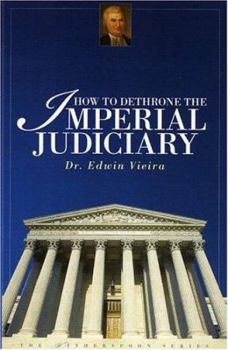
How To Dethrone The Imperial Judiciary


Select Format
Select Condition 
Book Overview
The most important constitutional issues of this generation concern the meaning of the rule of law and the ability of the people to enforce true law by restraining runaway activist judges. For... This description may be from another edition of this product.
Format:Paperback
Language:English
ISBN:0975526413
ISBN13:9780975526415
Release Date:August 2004
Publisher:Vision Forum
Length:328 Pages
Weight:1.08 lbs.
Dimensions:8.5" x 0.8" x 5.5"
Customer Reviews
2 ratings
understanding the constitutional function of the judiciary
Published by Thriftbooks.com User , 18 years ago
An excellent treatment of a complex subject. The main argument is extremely well supported. A fascinating work which should be read and understood by every American who cares about the constitution.
A Practical Guide to Dethroning the Out-of-Bounds Federal Judiciary
Published by Thriftbooks.com User , 18 years ago
~How to Dethrone the Imperial Judiciary~ is a well-researched book by Harvard jurist Edwin Vieira and published by the Vision Forum. The focal point of the book is the illegitimacy of Lawrence v. Texas, 539 U.S. 558 (2003), whereby the federal courts bullied the State of Texas and other sovereign states decrying their prohibition of sodomy as unconstitutional. Public morality statutes of this sort serve a purpose. Somehow, the right to sodomy was hidden in "the penumbras and emanations" of the Ninth Amendment. All the other previous judges just looked over it apparently. Sarcasm! As Justice Scalia, the voice of reason and dissent has exclaimed, "Day by day, case by case, this court is busy designing a Constitution for a country I do not recognize." So, here is a point to ponder: if the federal judiciary fails to exercise its authority to construe the law properly, then are usurpations somehow vindicated because the judiciary fails to adjudicate justly and strike down usurpations of the law? An unconstitutional statute is not a "law" though it may have the "color of law" when sustained by judicial fiat. Thus, the exercise of a more judicial edict without lawful authority is not binding or obligatory. Justices on the bench in a reflective moment of sobriety have affirmed the primacy of the Constitution itself to court rulings: "[T]he tendency to encrust unwarranted judicial interpretations upon the Constitution and thereafter to consider merely what has been judicially said about the Constitution, rather than to be primarily controlled by a fair conception of the Constitution... But the ultimate touchstone of constitutionality is the Constitution itself and not what [some majority of the Supreme Court] have said about it." Hence, judicial fiat does not justify the constitutionality of an unlawful statute nor does it confer any constitutional authority for any public official to enforce it. Encroachment upon the reserved rights of the States as well as the coercion of a State has always been averse to the principles of republican government. Guarding against the potential usurpation of state prerogatives was a perennial concern during the heated constitutional debates. It should be duly noted that many Federalists moved to alleviate that fear of federal usurpation by conciliating themselves to a states' rights reading of the Constitution. Hamilton asserted in Federalist #33: "But it will not follow... that [Legislative Acts]... which are not pursuant to its constitutional powers, but which are invasions of the residuary authorities of the smaller societies, will become the supreme law of the Land. These will be merely acts of usurpation, and will deserve to be treated as such." In his erudite book Vieira defends the doctrine of state interposition against federal usurpation. According to the American Jurisprudence encyclopedia: "The general rule is that an unconstitutional statute, though having the form and name of law, is in reality no law,
Copyright © 2026 Thriftbooks.com
Terms of Use | Privacy Policy | Do Not Sell/Share My Personal Information | Cookie Notice | Cookie Preferences | Accessibility Statement
ThriftBooks ® and the ThriftBooks ® logo are registered trademarks of Thrift Books Global, LLC
ThriftBooks ® and the ThriftBooks ® logo are registered trademarks of Thrift Books Global, LLC
