


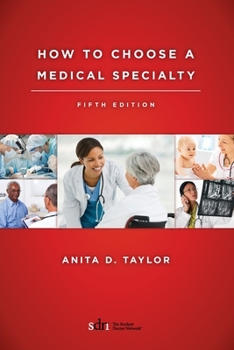
How to Choose a Medical Specialty

Select Format
Select Condition 
Book Overview
Addresses the process of choosing a medical speciality with unique information on self-assessment, options to consider, and trends among women, minorities, osteopathic physicians and couples.... This description may be from another edition of this product.
Format:Paperback
Language:English
ISBN:1938223659
ISBN13:9781938223655
Release Date:December 2012
Publisher:NACSCORP, INC
Length:524 Pages
Weight:1.64 lbs.
Dimensions:9.0" x 1.2" x 6.0"
Customer Reviews
5 ratings
Good book for introspection and discovery
Published by Thriftbooks.com User , 17 years ago
Recent reviews dinged this book for lacking specifics, not giving information. I personally found this book to be very useful in my search for a medical specialty. There were stats and numbers given on each specialty, so I'm not sure what people mean about lacking specifics. A unique value was the beginning section - very useful in giving exercises asking myself what kind of practice and values were important to me. The specialty that I ultimately chose, ophthalmology, was completely off my radar and would not have been discovered had I not used this book. Each specialty listed has a little "quiz" at the end where you rank items of importance (e.g., Opportunities to use my hands, Patient continuity, New technology), and then you get a personalized "score" for each specialty. Ophthalmology ranked among the very highest, to my great surprise. So, I tried a couple of rotations in ophthalmology as a medical student and really enjoyed it... and now am an ophthalmology resident - overworked and underpaid (which resident isn't), but quite happy with my choice!
A must-have to every medical student !
Published by Thriftbooks.com User , 23 years ago
Most medical students are hesitant to choose their medical specialty. No book until now has solved this dilemma in a proper way except this one! I was asking myself this question before graduation, and I saw this book at the Toronto Bookstore 2 years ago, but didn't want to buy it cuz one of my friends told me that there were many web sites which will help you choose your future specialty. Unfortunately, I didn't find a comprehensive book or at an article or a website about that. Then after graduation, I had the chance to visit Toronto Bookstore again and decided this time to buy it!Part I: The Challenge of Specialty Choice including (Planning your specialty choice, Finding a speciality that is right for you, Considering your options, Career planning in an uncertain world).Part II: The Specialties and Subspecialties including: Allergy and immunology, Anesthesiology, Colon and rectal surgery, Dermatology, Emergency medicine, Family medicine, Internal medicine (Cardiology, Endocrinology and metabolism, Gastroenterology, Hematology, Infectious diseases, Medical oncology, Nephrology, Pulmonary disease, Rheumatology), Medical genetics, Neurological surgery, Neurology, Nuclear medicine, Obstetric and gynecology, Ophthalmology, Orthopedic surgery, Otolaryngology - Head and nech surgery, Pathology, Pediatrics, Physical medicine and rehabilitation, Plastic surgery, Preventive medicine, Psychiatry, Radiation oncology, Diagnostic radiology, Thoracic surgery, Urology.A composite picture of each specialty is drawn in terms of (General information, Residency information, American Board of medical specialties certification, Supply and projections, Economic status and types of practice, Further information, Why choose this specialty, What do you like most about this specialty, What do you like least about this specialty, What is your typical daily schedule, What abilities and talents are important in this specialty, what personality traits best characterize this specialty, what advice would you give to medical students interested in this specialty, what are the future challenges to this specialty, Job values of this specialty)Part III: Emerging Specialty Areas including: (Addiction medicine, Administrative medicine, Adolescent medicine, Critical care medicine, Geriatric medicine, Hospice and palliative medicine, Sports medicine, Women's health).Part IV: Practice Options inlcuding (Clinical pathways, Non-clinical pathways, Geographic location).Part V: After You Have Chosen a Specialty including (Planning for residency, Military programs, The couples match, Shared-schedule residencies, What happens if you don't match, Changing specialties during residency and afterwards).Appendix which contains: Quesionnaire, First-year postgraduate positions offered through the National Resident Matching Program (NRMP), Residency competitiveness tables, Summary profile scores, Selected web sites.This book comes in 331 pages. I hope there will be an update for it since its last 3r
A VERY helpful and thorough book!!
Published by Thriftbooks.com User , 25 years ago
This book is filled with answers to the common questions a prospective medical student might ask a practicing physician. Every specialty is reviewed with the same general and specific questions: "How much do they make?"; "How long is the residency?"; What is your typical day like?"; and "What do you like the least and best in your field?" Ms Taylor also reviews emerging specialties. This book was EXTREMELY helpful and I recommend it to all newly accepted and attending medical students.
An excellent resource!
Published by Thriftbooks.com User , 25 years ago
I will be beginning Med School this fall, and I was still questioning what field would make me most happy. This book was able to solve that mystery for me. This edition is new, and updated, and all of her data are recent. She guides you through every field of medicine, including new fields like Medical Genetics, and Radiation Oncology. This is a must read for any Med student (or Premed) who is unsure of their future goals. This book will remain usefull throughout Med School, as it also contains important information about the residency match program.
A book every medical student should read.
Published by Thriftbooks.com User , 27 years ago
With the bewildering myriad of specialties available, it's overwhelming for medical students to attempt to decide what to do with the rest of their lives. Even if you think you know what you want to do, this book will help confirm (or perhaps deny) your choice, as well as open your mind to other possibilities. Research has shown that physicians are most satisfied with their particular specialty when it matches their personality type. Hence, Ms. Taylor attempts to help students pick specialties based on their personality characteristics. She also includes helpful information on lifestyle, income, and much more. The one drawback to this book is its age; it's been 7 years since the latest (2nd) edition was published, and some of the statistical information is outdated, although the basic concept has stood the test of time. I hope that Ms. Taylor decides publish a 3rd edition in the near future, as this book is invaluable and a must have for every medical student.
Copyright © 2026 Thriftbooks.com Terms of Use
| Privacy Policy | Do Not
Sell/Share My Personal Information | Cookie Policy | Cookie Preferences | Accessibility Statement
ThriftBooks® and the ThriftBooks® logo are registered trademarks of Thrift Books Global, LLC
ThriftBooks® and the ThriftBooks® logo are registered trademarks of Thrift Books Global, LLC
