


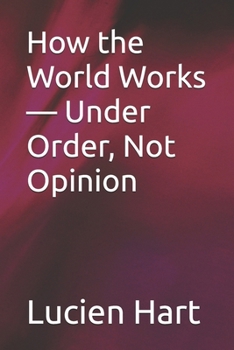
How the World Works - Under Order, Not Opinion

Modern societies appear active, sophisticated, and highly coordinated-yet increasingly fragile.
Economic systems respond constantly but struggle to recover. Institutions remain operational but lose credibility. Individuals work harder while feeling less secure. Crises no longer arrive as isolated shocks; they expose weaknesses already embedded in daily life.
This book argues that the problem is not failure, but malfunction.
Rather than focusing on ideology, politics, or moral blame, How the World Works examines civilization as an integrated structure-one that depends on boundaries, compartments, and authority remaining correctly aligned. When those structures are quietly dismantled, societies do not immediately collapse. They continue to function, but lose the ability to repair themselves.
Through a structural analysis of labor, supply chains, globalization, authority, and religion, the book traces how modern civilization shifted from stability to exposure. It explains why the removal of compartments-once essential buffers against risk-produced systems that require constant correction and centralized control.
The book also addresses a question often avoided in contemporary discourse: why societies need religion, and why religion cannot replace society. Religion is presented not as doctrine or belief, but as a structural role-one that establishes non-negotiable limits beyond human discretion. Society, in turn, is the domain of action, responsibility, and consequence.
When these roles are confused, substitution occurs. Markets, states, ideologies, or technologies begin to claim authority they cannot restrain. Efficiency replaces judgment. Performance replaces legitimacy. The result is not freedom, but fragility.
How the World Works does not propose a new system or policy agenda. It does not ask readers to agree, only to recognize patterns already visible beneath surface debates. Its central claim is simple:
Civilizations endure only when action operates under recognized order.
Written for readers seeking clarity rather than persuasion, this book offers a concise structural diagnosis of how modern societies drifted off course-and why no amount of optimization can replace boundaries that were never meant to be negotiated.
Customer Reviews
ThriftBooks ® and the ThriftBooks ® logo are registered trademarks of Thrift Books Global, LLC
